Category: Wk06-1950 World Cup

  • The Pitch as a Mirror

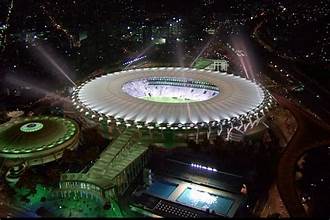
    Reading through these pages of The World Cup as World History really drives home the idea that soccer is never “just a game”—it’s more like a massive, high-stakes therapy session for entire countries. In 1950, Brazil built the Maracanã stadium as this huge monument to their own greatness, basically planning a national party to prove they were a modern, unified “racial democracy.” But when they lost the final to Uruguay, the mask slipped. Instead of sticking together, the public immediately started blaming the Black players, like goalkeeper Moacir Barbosa, showing that their “unity” was pretty much a myth the second things went sideways.
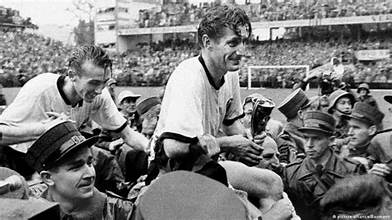
    Then you look at West Germany in 1954, and it’s the exact opposite vibe. They were still digging out from the wreckage of WWII and carrying massive national guilt, but then they pulled off the “Miracle of Bern” by beating a legendary Hungarian team. It wasn’t just a trophy; it was like the country finally got a “get out of jail free” card to feel proud again without it being tied to their dark past. For them, 11 guys on a pitch did more to rebuild the national spirit than any politician could have at the time.

    Honestly, what I took away from this is how much we project onto these players. In 1950, a loss exposed Brazil’s deep-seated racism, while in 1954, a win gave Germany a brand-new identity. It’s wild to think that 90 minutes of chasing a ball can literally change how millions of people see themselves. Whether it’s a “national funeral” in Rio or a “rebirth” in Bern, the scoreboard ends up writing the history books as much as the sport.
  • More than a Game

    Reading Bowman and Campomar made me think about how the World Cup is never just about soccer. It feels like a space where countries try to show who they are, but also where that identity can get questioned or reshaped. Bowman points out that even when governments or big organizations try to control the meaning of the tournament, they cannot fully do it because the game itself is unpredictable and fans bring their own emotions and interpretations. That idea stood out to me because it shows how sport can slip away from political control even when people try to use it for a specific message.

    Campomar’s chapter in Golazo! adds another layer by showing how football changed once it reached Latin America. Even though the sport came from Europe, it did not stay European for long. Local communities adapted it and made it their own, turning it into something connected to pride, culture, and everyday life. I thought this was interesting because it challenges the idea that culture only moves one way from powerful countries outward.

    Together, these readings suggest that football sits in a constant tension between power and popular culture. The World Cup can reflect global inequalities, but it also gives players and fans a way to create new meanings that governments cannot fully control. What makes the tournament so important is not just the competition but the way it becomes a stage where identity, pride, and politics all mix together.

  • Post-WW2 Football and Politics

    Football defeats can shape national identity just as much as victories can. Both texts for this week tell us that the postwar World Cup became a stage where politics and identity were fought for in front of a global audience. Andreas Campomar focuses on the story of the Maracanazo at the 1950 FIFA World Cup. Brazil hosted the first World Cup after World War II in an effort to present itself as a modern nation, and the newly built massive Maracanã stadium became a symbol of that progress into modernity. Brazil needed only a draw against Uruguay to claim the title, but Uruguay came out victorious, sending shockwaves across the world and devastating Brazil. Campomar shows that this was more of a national crisis than a loss. Players, particularly goalkeeper Barbosa, were scapegoated for decades. The defeat challenged Brazil’s confidence and forced a deep rethinking of national identity.

    The main argument from the reading is that this loss ultimately “made” Brazil. The trauma led to structural and cultural changes in Brazilian football like new tactical discipline and deeper psychological preparation, as well as the development of a unique style of football (Joga Bonito) blending artistry with resilience. The pain of 1950 laid the foundation for Brazil’s later dominance where they would go on to win 3 world cups in a short period of time in 1958, 1962, and 1970. 

    Bandyopadhyay’s analysis of the postwar World Cup era complements this narrative by situating 1950 within larger global shifts. The FIFA World Cup after 1945 was not just a tournament, but also a symbol of recovery and new geopolitical realities. The Cold War shaped competitions like the 1954 World Cup, where West Germany’s victory was a massive morale boost and helped the nation get back on track with the global community. At the same time, decolonization expanded FIFA’s membership, as African and Asian nations became better represented on football’s biggest stage. 

    The Maracanazo shows us that football history cannot be separated from world history. The same forces reshaping also reshaped the sport. What stood out to me most is how a single match could leave scars that influenced decades of cultural and sporting development, proving that sometimes defeat can change a nation more than triumph.

  • Differences in Approaches to Injury and Violence by Bowman and Campomar

    While reading chapter two of Bowman’s The World Cup as World History and chapter six of Campomar’s Golazo! I found a difference in their approaches to injury and violence as pertaining to the sport of soccer.

    Injury and violence has been imbedded in the sport and it’s accompanying tournament since it’s early days. It isn’t something that should surprise anyone interested in this sport and it’s history. Yet, the way that Bowman and Campomar mention this topic differs.

    Campomar seems to uses injury and violence almost as a sort of comedic break in between analysis of games. Here are some examples from chapter six:

    “Fortunately for Brazil, the Red Star Belgrade striker, Rajko Mitic, cut his head on a steel beam in the as-yet-unfinished stadium and could not start the game.” (pg. 212)

    “The Uruguayans now became swift and assured in attack, much to the astonishment of a crowd, whose attention had been momentarily diverted by a corpse being taken out of the stadium.” (pg. 217)

    “Although Buchan’s approach, in comparing crowd etiquette [Latin America and Europe], was rather high-handed, not to say xenophobic: he had a point: English referees were not renowned for brandishing pistols during matches.” (pg. 224)

    “Ellis would later recount in his memoir, ‘I haven’t been to Brazil for many years, I was told that if I dared to step into the country [Brazil]…I would be shot’” (pg. 229)

    All the quoted material above, especially those from page 217 and 224 respectfully, stand out from the text surrounding them. They force the reader to pause and re-read to make sure they understood what they just read.

    Campomar’s writing style, especially when discussing injury and violence, seems to reflect the target audience of his book: a more general public than that which Bowman targets. Bowman, targeting a more academic audience, refrains from as abrupt – seemingly snuck in – mentions of injury and violence. He, on the other hand, uses examples of injury and violence as ways of furthering discussion. This is evidenced in the following quote from Bowman:

    “When asked about the on-the-ground situation in the World Cup host country, Berti Vogts, captain of the West German squad, re-plied: “Argentina is a country where order reigns. I haven’t seen any political prisoners.” At the time, executions were being carried out in Buenos Aires.” (pg. 62)

    This quote was pulled from the end of a large paragraph discussing the political concerns of hosting the 1978 World Cup in a country under the control of a military junta. It serves to make a point in and of itself, unlike Campomar who uses examples of injury and violence as shock rather than to further discussion.

  • Politics and national identity

    The post-war World Cups were filled with corruption and political bias. This is a common occurrence I’ve noticed throughout this course. The 1950 World Cup is a prime example of the persistent political influence on the FIFA World Cup. Bowman writes about Brazil’s goals to prove themselves not only in terms of football but also politically, economically, and culturally. Following Brazil’s shocking loss during the final match against Uruguay, there was the racial scapegoating targeting players of African descent. The blame shifted to one player, in particular, goalkeeper Moacir Barbosa. Ultimately, Barbosa became a symbol of national failure. Barbosa’s blame stands as a testament to how the interwining of racial bias into the FIFA World Cup can affect the players and the team.

    Another point that stood out to me in the readings was the “Football War.” In the 1969 qualifying matches, there was a huge outbreak of violence between El Salvador and Honduras. Furthermore, the “Football War” was the final trigger in a deep-seated conflict over land, immigration disputes, and economic inequality. Moreover, this “War” is a stark reminder of how the World Cup is woven into politics and racial bias. The World Cup provides people with a sense of national pride and unity, which is often exploited and used as an instrument for political propaganda and brainwashing. The treatment of goalkeeper Moacir Barbosa and the “Football War” highlights the recurring theme of the political ties in the FIFA World Cup. Furthermore, they emphasize how these political ties can lead to violence, disputes, and conflicts.

  • Week 6

    This module made it clear to me how global sports relate to American history and world events. As Bowman notes the World Cup is not only about the game itself but also about the political power, nationalism, and global change.  Different countries have been able to use the tournament to transmit identity and influence. Bowman (2020) describes such an example whereby hosting the World Cup has the power to influence and affect the way the world would view a nation. This made me understand that sport is applicable not just in the entertainment sector but also in the diplomacy sphere, as well as in the international relations field.

    The module also helped me to connect a sport to the larger historical events in American history, like globalization and the media explosion. Whereas soccer has never been regarded as a very popular sport in the United States, such events as the 1994 World Cup conducted in the United States demonstrated how the latter country engages in the global culture. According to Bowman (2020), the World Cup became a global event, with millions of viewers due to the popularization of television and the presence of corporate sponsorship.  This is related to American economic power and global business development. I got to know that such bodies as FIFA possess immense political and financial resources, which casts doubt on leadership and fairness.

    Among the findings that I have had is the fact that global tensions are usually reflected in the World Cup. According to Bowman (2020), certain tournaments have been associated with political wrangles and demonstrations, even boycotts. This demonstrates the fact that both sports and politics are closely related. I did not expect it to be so heavily planned and involve the government in any way to host the event. It taught me that international sports events also have both negative and positive impacts on the community in a given location.

    Some aspects that I would like to know about FIFA are how decisions are made within the FIFA organization and how corruption has resulted in a tarnished image of the organization. I am also curious how the human rights issues are going to find their way into future World Cups. On the whole, this module enabled me to consider in a more profound way the interrelation of sports with history, politics, and global transformation.

  • 1916: A year to remember

    Between the two readings, they were both about the 1916 event. One specifically talks about the 1916 event in Buenos Aires. The other article talks about the Unification between rivals and how the Conmebol organization came to be. It reveals the excitement at the time when both are preparing for the games. It also reveals how far the sport has come and proves how the game of soccer continues to progress. This week’s writing assignment will go into detail about these two stories. Hopefully it can be explained well in this week’s blog and bring a better understanding for the reader.

    In 1916, 25 Uruguayans were prepared for games in Buenos Aires. They were also talks of centenaries during the time. At this time they were still very much haunted from the 1910 games. This was also the first event of South American supremacy. This was because Uruguay, Brazil and Chile had joined together for the event. This was something extraordinary and new. It was something that had never happened before and for sure brought much excitement. Many people were for sure ready for it, including the players and the organizers running the event at the time. But this is where the second article intertwines with the first one.

    On June 18, 1916, representatives of Brazil, Chile and Argentina had joined together. This also led to rivals working together. This was something that brought excitement. It was a new chapter in the sport of soccer. On December 16, 1916, it was ratified and the creation of the confederacion Sudamericano de football also known as the Conmobel was official. This led to resolved conflicts and was something in hopes of a better future. It is very interesting how both of these things happened at the same time.

    Both of these events had been monumental. It was a new era, one focus on the games while the other was focused on a new creation. 1916 must have been a year for the sport of soccer. And with these stories from both articles, it must have honestly been something around that time in soccer history.

  • The World Cup and Brazil

    After the conclusion of the Second World War, the FIFA World Cup would continue to be used for political gains, especially by the nation of Brazil, who became completely enamored with the sport of Soccer.

    Brazil was looking to prove themselves economically, politically, and as a soccer powerhouse.  With their hosting of the 1950 World Cup (the first one since 1938), they were looking to accomplish their goals.  They built a massive stadium, the Maracana, to showcase that they were all in on the sport.  They almost succeeded in winning the World Cup in front of their home crowd, but would end up getting upset 2-1 by Uruguay.  This upset loss stunned Brazilians, which led to author, Nelson Rodrigues, saying, “Our catastrophe, our Hiroshima, was the defeat by Uruguay in 1950.”  This would continue to be viewed as the worst thing to ever happen to Brazil until 7-1.

    The 1958 World Cup would also be important to the nation of Brazil, where they finally won their first World Cup.  This one was not hosted in Brazil, but rather was hosted in Sweden, who they would defeat in the final match, finally showcasing to the world that they were the country to beat.  This World Cup was also important as it was the first time that a nation won the World Cup that was not on the continent in which it was hosted, showing that they didn’t need that home advantage to succeed.  This feat would be accomplished three more times: 2002 with Brazil, 2014 with Germany, and 2022 with Argentina.  Brazil would go on to win the World Cup four more times, including a repeat win in 1962, being the second team to accomplish this feat after Italy in 1934, and 1938.  Brazil’s five World Cup victories are the record for most World Cups by any nation.

    Like most nations, Brazil has used the FIFA World Cup for political, and economic reasons, and there likely isn’t any other nation that has been so involved in the sport.  With their victories showing the world that they are a powerhouse, and their losses being viewed as national tragedies, the sport of Soccer has been a key aspect of the culture of Brazil.

    By Tommy Oneto

  • World cup shaping national identity

    After World War 2, the World Cup became much more than just a soccer tournament, it evolved into a major political and cultural event. In The World Cup as World History, Bowman explains how global competitions pushed nations to consider whether soccer could reduce political tensions or actually intensify them. The 1950 World Cup in Brazil serves as a strong example. Brazil viewed hosting the tournament as an opportunity to present itself as a modern, powerful nation. The country built the massive Maracana stadium and invested heavily in the event to showcase its growth and strength to the world. President Eurico Dutra even referred to the players as “authentic representatives of Brazil,” highlighting how closely national identity was tied to the team’s performance.

    However, Brazil’s loss to Uruguay in the final revealed the darker political and social divides of the sport. Rather than simply accepting defeat, many fans blamed the team’s Black goalkeeper, Barbosa. As both Bowman and Golazo! Chapter 6 illustrate, soccer does not only reflect national pride; it can also expose deep social divisions. In Brazil’s case, the loss intensified existing racial tensions, and it took years before another Black goalkeeper was given a place on the national team.

    Political tensions also influenced later tournaments, including the 1966 World Cup in England. Several African nations boycotted the competition due to limited qualification spots, while Latin American teams criticized what they perceived as European bias in officiating. These controversies contributed to structural changes within FIFA and eventually supported the rise of Joao Havelange, who advocated for greater representation of non European nations.

    Overall, the readings demonstrate that the World Cup is never solely about sport. It functions as a global stage where nations attempt to build pride, power, and international reputation. At the same time, it can expose inequality, political conflict, and social division. Soccer has the ability to unite people, but it can also bring existing national tensions to the surface.

  • The Importance of Football

    As the title states, this week the legacy and importance of the beautiful game was on full display. The period following World War Two saw an immense growth in the sport, ranging from the 1950 resuming of the World Cup in Brazil, to the election of Joao Havelange as the first Non-European President of Fifa, the World Cup was increasingly growing in importance.

    One thing that I knew before the readings this week is that football is of great importance for much of the worlds nations. This is seen all across the globe with football unifying people, creating opportunity, and creating a sense of shared passion. The readings this week drove home this point with lots of new information surrounding the topic.

    “Throughout the history of football’s foremost global event, the question was whether the game had the ability to ameliorate some of these tensions and play a constructive political role. Or, on the other hand, did the football matches tend to exacerbate existing political problems?” pg 61 of Bowman The World Cup as World History

    I think that this quote sums up the main idea of the readings very well. Focussing on their hosting, and importantly their subsequent runner-up finish of the 1950 World Cup, the Brazilian national team shows how football has the power to unite and divide.

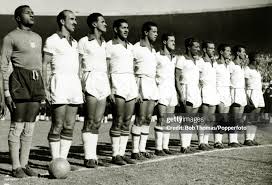
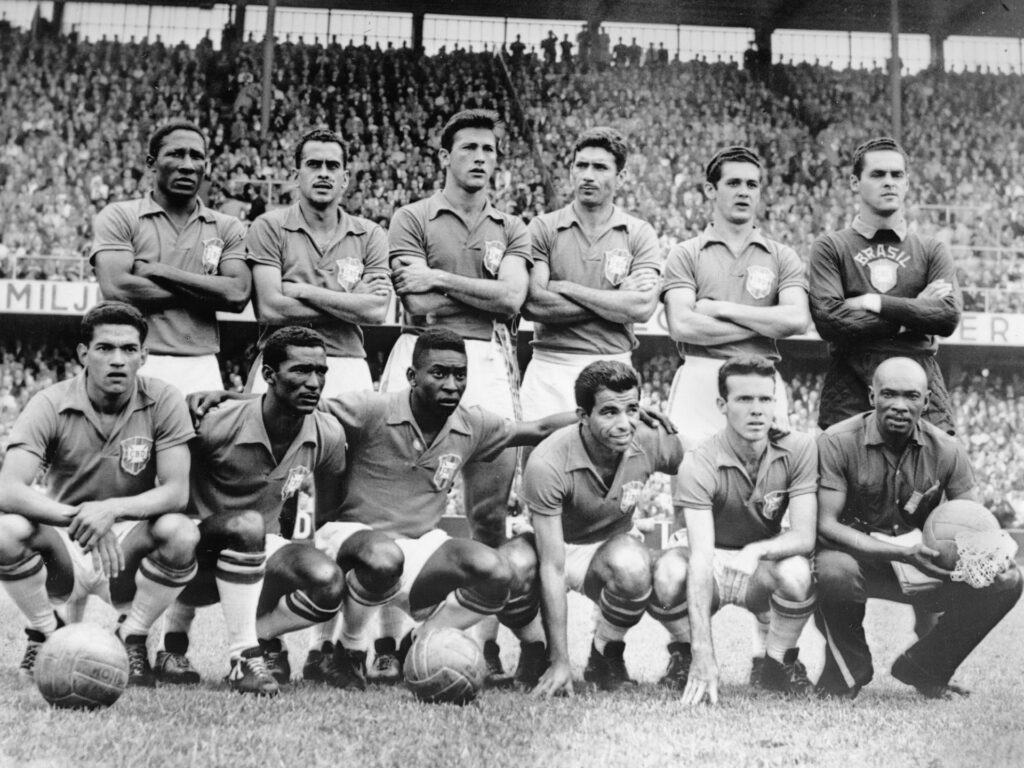
    Brazil’s 1950 World Cup Final Squad

    The 1950 World Cup was a spectacle for many reasons, it was the first World Cup post World War II isolation era of football, Brazil built a brand new stadium named Maracaná, and a moment for Brazil to highlight itself athletically, economically, and socially (themes that were very apparent in the world cups we have already covered in class)

    “You who I already consider champions… you take the field as authentic representatives of Brazil who will prove the worth of the Brazilian people to the entire world” a quote from the President speaking to the team prior to the World Cup Final Match against Uruguay.

    Now it is very clear how this World Cup presented such a promising sociopolitical opportunity for Brazil, so how does this prove that football can ‘exacerbate’ political differences?

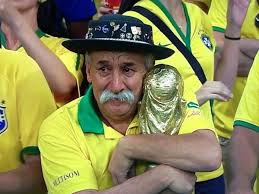
    Brazil ended up losing the match 2-1 to a Uruguay – a tragedy for the Brazilian fans, although not from that year (obviously) I think this picture shows how deeply football is rooted in Brazilian culture.

    Furthermore, this loss exacerbated the racism problem that was rattling Brazils society in the decades leading up to the World Cup. Many Brazilian fans blamed the loss on the African descended goalie – Barbosa. Some scholars even pointing out that it was decades until an African descended goalie was called up to the national team again.

    In conclusion, the World Cup is a beacon of hope for the host country to promote themselves to the world – however it can also have negative consequences domestically (as is the case in 1950).

css.php