There was alot of political and economic turmoil between countries after the end of World War II in 1945. Despite issues like the Cold War arising and wars in countries throughout Eastern Europe, Korea, and eventually Vietnam, FIFA was able to host a World Cup every four years without alot of issues.
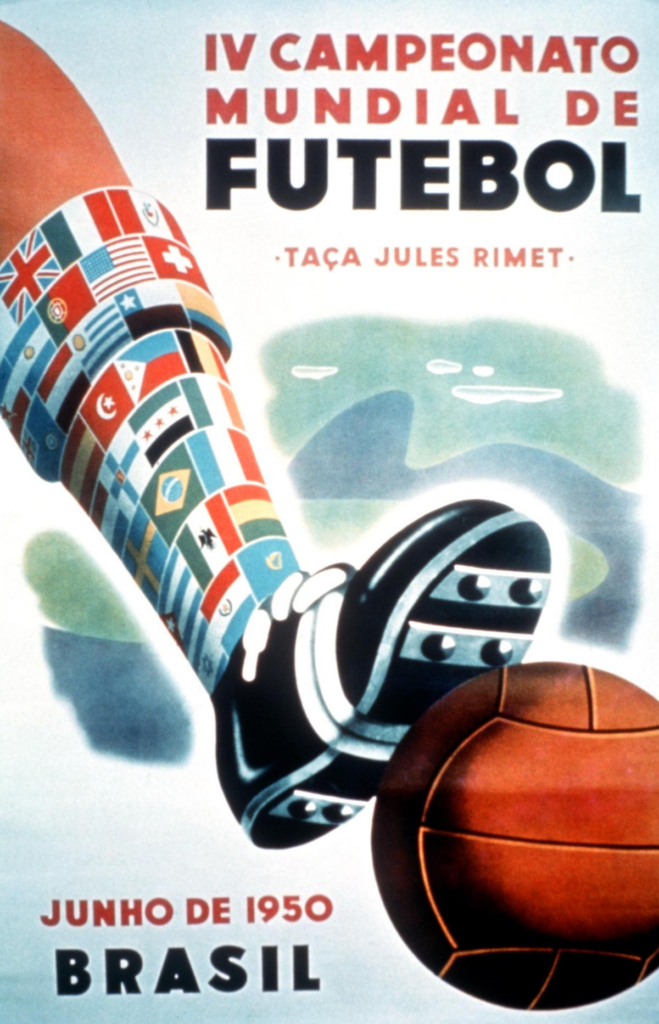
The 1950 World Cup took place in Brazil, and the Brazilian government was extremely excited to host the World Cup and prove that they were on the same level, if not better than, their European counterparts. The Brazilian government, in partnership with its football federation, developed elaborate plans for its national team and the competition. One of these plans included a brand new state-of-the-art stadium called Maracana, which hosted several key matches. Maracana was one of the largest stadiums in the world, and it was a testament to the global growth Brazil had been seeing during the time. The 1950 World Cup marked a change in how people viewed soccer because of how fanatacial brazillians were about their national team. The energy and support they showed for their national team were amazing.
Despite this support, Brazil would not be able to win the 1950 World Cup, as in front of an estimated 200,000 fans, Brazil lost 2-1 to Uruguay for the World Cup title. This disappointing result stunned Brazilians and left the country wondering what had happened. They had invested so much money and time; how could they not have won? Unfortunately, the answer most Brazillians came to was because of the race of some of the players, mostly those of african desecent. Brazil has been battling racial thinking and stereotypes for many years, but it seems that the World Cup only worsened those ideas for some Brazilians. In fact, it would be many years before the Brazilian national team would have another goalkeeper of African descent play for them. Thankfully, legends like Pelé would come to play for the Brazilian national team soon after this defeat, and many players of African descent would become national heroes in Brazil after winning the World Cup in 1958, 1962, and 1970.
The World Cup bounced around from South America to Europe every four years, and the choice of countries in Europe was mostly based on who had survived World War II without major damage, so countries like Switzerland and Sweden were chosen because they stayed neutral in the conflict years earlier. This eventually leads to the 1966 World Cup, which was hosted by england who is often viewed as the father of modern association rules football and is responsible for spreading the sport as far as it has been spread. England stayed out of the first couple of World Cups because they viewed it as below them, but when they actually started to compete in these global competitions, they started to lose to other countries realize that maybe they weren’t the top footballing country in the world anymore.
When the World Cup came to British soil, they knew that they had to make a statement and win the World Cup. They prepared meticulously for the competition and composed a team that reflected England’s political and cultural values to a tee. They brought together a team of hardworking and competitive men with enough scoring options to win matches. This World Cup was covered in controversy however, as a lot of African teams chose not to participate in their playoff matches and chose to boycott FIFA because they were only given one representative at the World Cup matches. There was also tension between teams as the Argentines were called animals by the British coach because of their more aggressive style of play, which, coupled with the extreme European bias of this World Cup, made it hard to play as a Latin American. And there was also a claim by a lot of German fans that there was some biased refereeing in the World Cup final they played against England that year. African, Asian, and Latin American teams felt slighted and betrayed by FIFA as an organization after this World Cup. This led to a lot of changes in FIFA as an organization and really helped to push for more representation of teams in the World Cup.