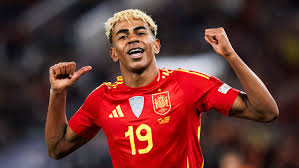
Category: Wk11-Spain and Futboleras

  • La Dictadura of Franco in Spain

    By: Abraham Cruz-Hernandez

    In “Spain: Fury and Failure” it examines the collapse of the Democracy in Spain during the 1930’s. That emphasized the double forces of the intense social conflict “Fury” and the political breakdown “Failure”. Throughout the article we can see how it argues that the Spanish descent into Civil War was not caused specifically by one thing but the accumulations of a lot of tensions that many democratic institutions around Europe could not handle.

    The “Fury” that is mentioned in the article can be described as the violence and hostility that occurred throughout the Spanish society as Franco took over. The clash was between working class, elites, left wingers, and right wingers. The issue occurred as left winger believed a reform was needed and right wingers believed that their reforms threatened society. Similar to how the United States is currently under where each political party hates the other and believes that the other party will be the end of the country. It actually did occur for Spain.

    Each political party in Spain ultimately did believe that it would be the end of Spain if whoever won the elections won. It unfortunately led to the 1936 Spanish Civil War where Franco took over and declared himself as leader and where his dictatorship would last until his last breath, which was around 40 years.

    You may be asking yourself what this has to do with soccer. Well Franco would use Real Madrid FC as the team that would be linked with Spanish Nationalism and part of the Central State. This also led to the regions of Spain to have extreme pride in their teams for example FC Barcelona is associated with the strong Catalan Identity and left leaning politics. Soccer will always be political no matter how hard many people will try to separate them.
  • Week 11: Spanish Soccer

    Our main reading piece for this week was “National Dissonance: The Copa del Ray Soccer Final as a Site of Political Influence” by Adam Winkel, and it covered how soccer is so integral to the regionalism felt throughout Spain and the effect it has on the fandoms of these regions. I am hoping to use this topic to find out more about how the interest in soccer and its processes have grown in the global youth and what it may look like in Spain.

    “Soccer fans enact their behavior as part of cultural performances, ‘occasions in which as a culture or society we reflect upon and define ourselves, dramatize our collective myths and history, present ourselves with alternatives, and eventually change in some ways while remaining the same in others’.”. With this tournament occurring annually, fans use this chance to either stand with their government or denounce it, and believing in a different dream of a “unified Spain”. Soccer is different in Spain, and we can see that ability of the sport to allow players to represent the countless regions in Spain while playing a game they just love, connecting that personal to national (or regional) identity.

    During the Franco Regime (1939-75) however, this understanding of “unity” and personal identity had come under lock and key due to the oppressive powers that controlled the country. As Winkel describes it, “..used the football pitch to enforce discipline and uniformity across Spain, one of the Franco regime’s main objectives”. Having a platform such as soccer that is able to reach just about anyone can be used, good or bad, for the purpose of reaching the fans and speaking to what they believe and want to hear.

    Our other reading for this week was Euro 2012: ‘Great Spain era’, says coach Vicente Del Bosque, and even though this was a shorter piece, the arguments made by Vicente seem like due to recent success for Spain on the international stage, these young stars cannot get complacent and need to understand that winning isn’t forever. The focus of this team should be on playing their own game and working together according to the teams strategies, regardless of how critics think.

    So many factors go into the politicization of soccer, yet in Spain, through the Copa del Rey, the government, players, and fans alike all get a voice and the opportunity to share their thoughts and beliefs, and as alluded to by Winkel, these “soldiers” that are the players, represent so much more than just the region.

  • Week 11 Blog Post

    It’s easy to think of soccer as something that brings people together. Big matches, shared excitement, the overall collective feeling when something awesome happens. But the more you look at Spanish football, especially something like the Copa del Rey final, the harder it is to hold onto that idea. Because if anything, I believe it shows how divided people already are.

    What stands out most is how much meaning gets layered onto moments that on the surface have nothing to do with the game. The anthem before kickoff, for example, isn’t just a formality. It becomes this flashpoint. Some fans sing, others whistle, and suddenly the stadium feels less like a sporting event and more like a political arena.And it’s not spontaneous either, it’s almost expected. People show up knowing what role they’re going to play.

    That sense of expectation ties back to an older way of thinking about Spanish soccer, the idea that it reflects something essential about the country itself. The “fury and failure” narrative tried to explain everything through national character. When Spain won, it was because of passion and strength; when it lost, there was always something else to blame.

    But that kind of thinking only works if you ignore the contradictions.

    Even in the 1960s, writers were already showing that the reality didn’t match the myth. Players weren’t just fearless competitors, they were pressured, shaped, and sometimes exploited. Fans weren’t just united, they were caught up in something bigger than the game, whether they realized it or not. The sport might look simple on the field, but everything around it was complicated.

    That’s what makes modern moments like the Copa del Rey final feel so charged. It’s not just that politics has entered the sport, it’s that it was never really separate to begin with. The match just concentrates on it. All the tension, all the identity, all the disagreement gets compressed into a single moment that everyone is watching.

  • Spanish Soccer: Politics, Power, and Fans

    Both National Dissonance: The Copa del Rey Soccer Final as a Site of Political Performance and Fury and Failure in Spanish Football Stories of the 1960s by Adam Winkel provide tremendous commentary on the intersection on politics and fandom in Spanish Soccer. Admittingly this is a topic that is of particular interest to me this semester as my research topic focuses on the political power/role of soccer in Catalunya.

    The role of soccer as a unifying (or a separating) power – both nationally or subnationally, as described in National Dissonance, comments how the Copa Del Rey tournament “has been a story that Spain has told about itself as ‘a single nation with the strong national identity or a conglomerate of nations with a variety of cultural identities.’”

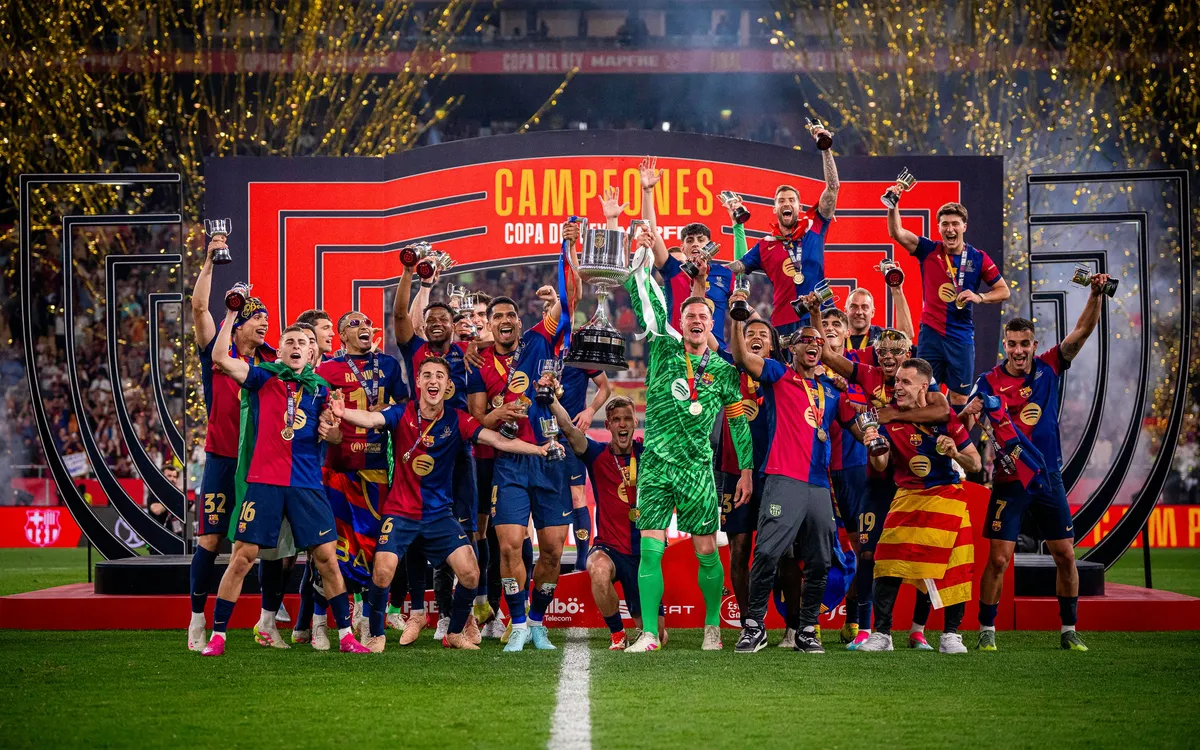
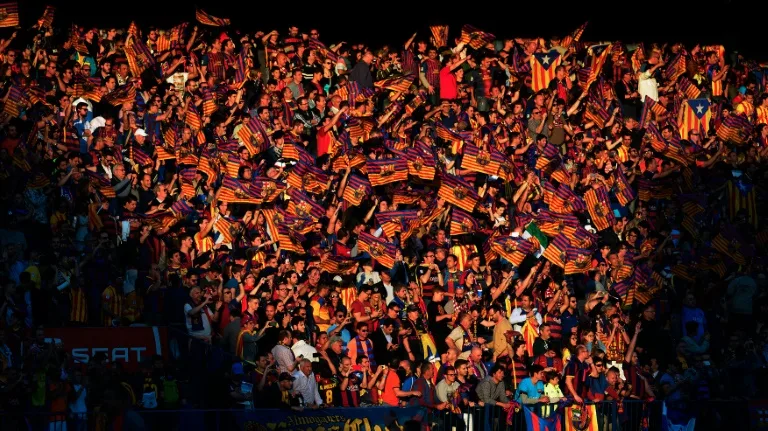
    The Copa Del Rey is a political tool on both ends of the spectrum – the fans and the government. The tournament itself holding many different names such as; Copa de S. M. El Rey de España, Copa de S.E. el Presidente de la República, Torneo Nacional de Fútbol, y Copa de S.E. el Generalísmo, shows that political figures (including Franco) have understood the importance of the sport as a political tool. Fans historically have also used these games as a their own medium by which to express their political views. Fans have taken to the stands across the history of the tournament to express their political views – in connection to my topic for the semester some Barca fans (located in Catalunya) whistle and jeer at the Spanish national anthem as a sign of protest for their independence.

    This connect hand-in-hand with Fury and Failure and the commentary it makes on the literature of the game. There are two quotes that I find impactful from this reading. “When football is written about it is already over, and when the article is read there is no longer any value in the match; all that exists is the value of the writing” a quote from Karl Ove Knausgaard and “it falls to literature, no matter how tentatively, to present the reader with the sentimental aspects of sport and sport fandom” highlight the importance of literature in this context. Both of these quotes outline the space that sports literature holds in the broader context of sport in Spanish society. This literature is inherently political and shapes the perspective of soccer in society – these topics in turn influence the greater political sentiment/power that soccer holds in spanish society. I really enjoyed these two readings.

    No matter how you cut it, soccer in Spain was, is, and will continue to be a political tool.

  • Week 11: Politicization and Regional Identity in Spanish Football

    Both “Fury and Failure in Spanish Football: Stories of the 1960s” and “National Dissonance: The Copa del Rey Soccer Final as a Site of Political Performance” show what football was like in Francoist Spain and how it functioned as a powerful social tool where national identity and resistance were constantly negotiated.

    A major theme connecting the two works is the use of football as a tool of the state. In “Fury and Failure”, Winkel shows how the Franco regime promoted football as a way to project strength and unity. Similarly, in “National Dissonance,” the Copa del Rey final is portrayed as a spectacle designed to garner national cohesion and loyalty. Ceremonies, symbolism, and media coverage were all orchestrated to present an image of a unified Spain under control, but in reality that was far from the truth.

    Both works emphasize that this image was never fully convincing. Despite the regime’s efforts, football consistently revealed the divisions within Spanish society. Regional identities, primarily in places like Catalonia and the Basque Country but also in many other regions of Spain, remained strong, and matches and major events became opportunities for fans to express these identities. What the state intended as propaganda often became a platform for alternative voices.

    Another shared theme is the role of emotion. In Fury and Failure, the concept of “fury” captures the “brutality and unsophistication of the Spaniards’ style”, as well as the intensity in which games were played by the Spanish teams. This emotional energy on the pitch is reflected by the broader social pressures in a repressive political system. “National Dissonance” complements this by showing how fans were not passive spectators. Their chants, reactions, and presence could reshape the meaning of an event, turning a state-controlled performance into something unpredictable and contested.

    What I found most interesting is how both works highlight the limits of authoritarian control. The Franco regime invested in shaping football as a symbol of unity, yet it could not fully control how people responded to it. As what became the case in many countries, stadiums became one of the few public spaces where emotions could be expressed collectively, and that made them relatively unstable from a political perspective. Even highly choreographed events like a national cup final could expose cracks in the system.

    Together, these readings reflect both the ambitions of the nation and the realities of its people. The regime saw the sport as a unifying force, but in practice it often amplified difference and dissent. That tension between control and expression is what makes the story of Spanish football in the 1900s so compelling, and so much more than just a history of sport.

  • Week 11

    This week’s module has furthered my knowledge of football, as I have learned that football is a significant site of political meaning, not merely entertainment. The idea of a “fury and failure” narrative in Spanish football has helped me to realize how national identity is created through stories that portray national character as passionate and strong, and how failure is explained in terms of external factors (Winkel, 2023). This has helped me to challenge my preconceived ideas and has shown me that football represents a country’s understanding of itself, particularly in terms of success and failure.

    What stands out most in these readings is how football acts as a tool of power, both at a micro and macro level. In the Spanish context, football was used under Franco to promote nationalism and a sense of unity, while masking underlying tensions in Spanish politics (Winkel, 2023). However, in the article on Copa del Rey, football is revealed not just as a tool of power from above, but also from below, through football fans’ actions. The final acts as a stage where identity is performed, as witnessed in acts such as booing the national anthem, which represents resistance and dissent in regions and politics (Winkel, 2020). On the other hand, The World Cup as World History reveals football as a tool of power on a global stage, with nations using football to project their identity, prestige, and power (Bowman, 2019). From these readings, football acts as a tool in constructing, performing, and projecting political identity.

    One such observation is the relationship between unity and division. Although the role of football is emphasized as being unifying, the Spanish experience indicates the existence of deep divisions between central and regional identities, which means football can also be seen as a force for division (Winkel, 2020). A significant question arises here: how aware are football fans of the fact that by engaging in football culture, they are expressing themselves politically as well?

    In conclusion, this module has altered my point of view because it has shown me football is a complex cultural system where identity, power, and politics are constantly being negotiated at both the national and global levels.

  • Local Identities in Spanish Football

    Football has a way of exemplifying local identities.  This is seen all over the world, and Spain is no different.  Through competition like La Liga, and the Copa Del Rey, these local identities are shown off.

    The Copa Del Rey, especially the final, has been seen as a battle of local identities, and national identity.  Currently, the Copa Del Rey has been used by teams and their fans for political expressions, mainly seen with FC Barcelona.  Barcelona is located in the Catalonia region of Spain, which has been the subject of political tension for quite some time, mainly with the rising of a Catalan self-determination movement.  This movement contrasted with a rise of nationalism in the nation.  At the time of Dr. Winkel’s writing, the Catalan independence movement was in full-effect, but has since died down.  Still, the political tensions of the time were showcased with football fans during the Copa Del Rey.

    Local identities have also been seen with the rise of FC Barcelona’s Lasmine Yamal.  During games, Yamal reps the neighborhood he grew up in, Rocafonda, by showing off the numbers, “304,” with a handsign.  Rocafonda, and the city of Barcelona as a whole have also embraced the young player, with comparisons to Lionel Messi, but while Messi was incredible for the success of the team, Yamal has the added benefit of being from Barcelona from the start.  The local identity is beneficial, as the team and the fans have fully embraced him as the future of their squad.

    While Yamal has been helpful with representing local identity, he has been proud to represent his Spanish identity too, especially in international competitions.  He even has gone as far as to guarantee (granted, while somewhat being edged on by the 60 Minutes interviewer) a world cup for Spain in 2026.  We’ll see how that ends up.  

    In conclusion, local and national identities, like in much of the world, have been a major part in the fandoms and operations of football clubs.  This fandom can showcase political tensions that can be seen in Spain, for better, or for worse.

    By Tommy Oneto

  • Crowning Champions, Dividing Spain: The Politics of the Copa del Rey

    What stood out to me in the article by Dr. Winkel was the meaning of soccer in Spain, particularly in the national tournament titled the Copa del Rey, or the King’s Cup. The tournament, founded in 1903, has been held under multiple political systems and highlights a deep connection between sports and politics. This is supported by evidence provided by Dr. Winkel in that the most successful teams to participate in the Copa del Rey often hail from regions in Spain that are large, urban areas where centralist and regionalist ideals clash. This is particularly interesting because Spain has multiple autonomous regions, and the winners of the Copa del Rey are crowned as the “Champions of Spain,” a title that implies superiority over other regions. At the same time, the tournament is regarded by the King as a unifying phenomenon, which creates a clear contradiction. I highlight this detail of holding a competitive tournament to crown the “Champions of Spain” while calling it unifying, as it is symbolic of the tensions between centralist and regionalist ideals.

    Another interesting detail is that competitors are selected based on their performance in their region and ultimately compete in Madrid most of the time for the championship, a city located near the center of Spain and associated with centralized power. Soccer in Spain is not just a spectacle for the game being played in the stadium, but also a political spectacle. A report in Winkel’s article emphasized the chanting of the dictator’s name at the final of the tournament in 1943, with fifty thousand spectators chanting “Franco!” The report deemed it a unanimous demonstration of patriotism and respect, showing that the focus was not on the match itself, but on the reception of the dictator by the crowd. This demonstrates how easily soccer events can be used for political messaging and influence. Ultimately, it is clear that sport and politics in Spain are deeply and inseparably connected, with soccer acting as a reflection of the country’s ongoing political tensions and identities.

  • Lamine’s Lament

    Euro 2024 final: Photographer who captured Lionel Messi with ...

    This week, I watched the CBS 60 Minutes segment about Lamine Yamal. Lamine is 18 years old and already a household name with many soccer fans. He is a soccer prodigy, and he has the reputation to back it up. He recently finished 2nd in the Ballon d’Or, world soccer’s MVP award, and has helped his team secure a victory at the World Soccer Championship in Germany. He was scouted by Barcellona when he was only six years old, and made his debut with the team when he was fifteen years old. 

    During the interview, he is asked about his “soccer superpower.” He humbly responds, saying that he just wants to brighten people’s day. Additionally, he claims that the soccer ball is his “first love”. He reinforces this by stating that if the ball could talk, he would “Ask it to marry me and to have lots of kids”. Later in the segment, a soccer analyst was asked how to describe him. He responded, saying, “How do you describe candlelight?” These descriptions make the grand scope of his career very interesting to me. As established in class, the non-American vision of soccer is incredibly romantic. This news segment and the interviews have further driven this fairy tale romanticism of the sport. 

    I think I have a good understanding of the view eastern nations have of the sport. But seeing it described about a player in this current time with a player younger than me has shown me that I couldn’t begin to understand it. I once met a guy from Scotland who was a die-hard Hearts fan and could talk for hours about it. He talked about the sport as if it were omnipotent and could hear him praise it. I knew he felt something about the sport i couldnt comprehend. This story held lots of similarities between that conversation, and i couldnt help but think about the divinity that soccer is to some people.

  • Political Soccer in Spain.

    What stood out to me in the article by Dr. Winkel was the meaning of soccer in Spain, particularly in the national tournament titled the Copa del Rey, or the King’s Cup. The tournament, founded in 1903 has been held under multiple political systems and highlights a deep connection between sports and politics. This is supported by evidence provided by Dr. Winkel in that the most successful teams to participate in the Copa del Rey often hail from regions in Spain that are large, urban areas that contain the clashing of centralist and regionalist ideals. This is particularly interesting because Spain has multiple autonomous regions and the winners of the Copa del Rey are to be crowned as the “Champions of Spain”, where the title has a connotation that indicates and implies superiority over the other regions of Spain with the tournament being regarded by the King as a unifying phenomenon which is simply just a contradictory statement for the King to make. I highlight this detail of holding a competitive tournament to crown the “Champions of Spain” while calling it unifying as it is symbolic of the tensions between centralist and regionalist ideals. Another interesting detail to note between the clashing of centralist and regionalist ideals is that the competitors of the tournament are selected based on their performance in their region and ultimately compete in Madrid most of the time for the championships which is a city that is close to the center of Spain, although a majority of the time does not necessarily mean that every single championship is held in Madrid. Soccer in Spain is not necessarily just a spectacle for the game being played in the stadium, but also a political spectacle. A report in Winkel’s article emphasized the chanting of the dictator’s name at the final of the tournament in 1943 with fifty thousand spectators chanting “Franco!”. The report deemed it as a unanimous demonstration of patriotism and respect. It was clear that the focus was not on the match of soccer being played, but the reception of the dictator to the audiences of Spaniards in the stadium. It is a clear conclusion that sport and politics in Spain are innately connected.

css.php