Blog
-
The post-war World Cups were filled with corruption and political bias. This is a common occurrence I’ve noticed throughout this course. The 1950 World Cup is a prime example of the persistent political influence on the FIFA World Cup. Bowman writes about Brazil’s goals to prove themselves not only in terms of football but also politically, economically, and culturally. Following Brazil’s shocking loss during the final match against Uruguay, there was the racial scapegoating targeting players of African descent. The blame shifted to one player, in particular, goalkeeper Moacir Barbosa. Ultimately, Barbosa became a symbol of…
-
This module made it clear to me how global sports relate to American history and world events. As Bowman notes the World Cup is not only about the game itself but also about the political power, nationalism, and global change. Different countries have been able to use the tournament to transmit identity and influence. Bowman (2020) describes such an example whereby hosting the World Cup has the power to influence and affect the way the world would view a nation. This made me understand that sport is applicable not just in the entertainment sector but also…
-
Between the two readings, they were both about the 1916 event. One specifically talks about the 1916 event in Buenos Aires. The other article talks about the Unification between rivals and how the Conmebol organization came to be. It reveals the excitement at the time when both are preparing for the games. It also reveals how far the sport has come and proves how the game of soccer continues to progress. This week’s writing assignment will go into detail about these two stories. Hopefully it can be explained well in this week’s blog and bring a…
-
After the conclusion of the Second World War, the FIFA World Cup would continue to be used for political gains, especially by the nation of Brazil, who became completely enamored with the sport of Soccer. Brazil was looking to prove themselves economically, politically, and as a soccer powerhouse. With their hosting of the 1950 World Cup (the first one since 1938), they were looking to accomplish their goals. They built a massive stadium, the Maracana, to showcase that they were all in on the sport. They almost succeeded in winning the World Cup in front of…
-
After World War 2, the World Cup became much more than just a soccer tournament, it evolved into a major political and cultural event. In The World Cup as World History, Bowman explains how global competitions pushed nations to consider whether soccer could reduce political tensions or actually intensify them. The 1950 World Cup in Brazil serves as a strong example. Brazil viewed hosting the tournament as an opportunity to present itself as a modern, powerful nation. The country built the massive Maracana stadium and invested heavily in the event to showcase its growth and strength…
-
As the title states, this week the legacy and importance of the beautiful game was on full display. The period following World War Two saw an immense growth in the sport, ranging from the 1950 resuming of the World Cup in Brazil, to the election of Joao Havelange as the first Non-European President of Fifa, the World Cup was increasingly growing in importance. One thing that I knew before the readings this week is that football is of great importance for much of the worlds nations. This is seen all across the globe with football unifying…
-
The world cup openly has lots of controversy through proven situations and public gossip stating whether certain things are fair or not fair. Bowman goes into depth on the England world cup in 1966 and the 1978 world cup in Argentina. According to reporters and other recognised people both world cups had bad reputations. In 1966 there was lots of political tension with African countries boycotting the competition due to the limit sport the continent had been allowed, lots of latin american countries believed there was a bias towards the europing nations from the referees. Not…
-
“You who I already consider champions…. you take the field as authentic representatives of Brazil who will prove the worth of the Brazilian people to the entire world” -Eurico Dutra, President of Brazil. This quote in my opinion encapsulates an important motif of both the Golazo reading and the Bowman reading which is that at the highest level of association football, they are essentially ambassadors to the world stage; a symbol of the country and it’s overall prowess in the eyes of the other countries at the World Cup. Being able to host the World Cup…
-
There was alot of political and economic turmoil between countries after the end of World War II in 1945. Despite issues like the Cold War arising and wars in countries throughout Eastern Europe, Korea, and eventually Vietnam, FIFA was able to host a World Cup every four years without alot of issues. The 1950 World Cup took place in Brazil, and the Brazilian government was extremely excited to host the World Cup and prove that they were on the same level, if not better than, their European counterparts. The Brazilian government, in partnership with its football…
-
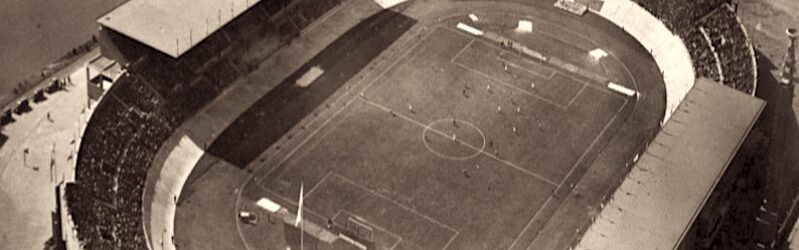
Snapshots of Modernity shows how Uruguay became a powerhouse in soccer by hosting the first ever World Cup in 1930. The article shows how photography helped Uruguay present itself as a modern in progressive nation during its centennial celebrations from its independence of Brazil. The photographs help highlight, new stadiums, huge crowds, and heroic athletes, who is symbolize technological advancements and a civic unity. The images of packed stands and thrilled spectators, suggested a Democratic participation which portrayed soccer as a shared national experience, that appeals to all sorts of class divisions. They emphasize masculine athleticism,…
