Blog
-
Pictured above is the 1930 Uruguay World Cup Championship Team Both of these articles represent political influence on sports, especially how national identity being is being shaped, reinforced, and portrayed in sports. This is evident in the 1916 Campeonato Sudamericano held in Buenos Aires. After much reluctance, the Uruguay team chose to include Black players Juan Delgado and Isabelino Gradin. “In their defence of their Black compatriots Uruguay seemed to reaffirm the country’s whiteness, to deny and denigrate its African heritage. Delgado and Gradin’s heritage. As if their descendants had not been forced across the Atlantic.…
-
For the two readings that were assigned this week, I noticed a distinct theme between the two of them. There is a connection to politics within football with some interesting nuances to it. In one scenario, Uruguay in the early 20th century was eager to prove itself in international competition among other South American nations as well as the nations that span the rest of the world. This came after victories in the Olympics as well as becoming a global leader in staging football competitions and celebrating one hundred years of political independence. There is more…
-
When sports and politics intersect, global events like the World Cup reveal how power and national identity are actively constructed rather than simply displayed. Bowman and Gordon & London show that the World Cup has never been a neutral celebration of sport. Instead, it has functioned as a stage where nations assert authority, legitimacy, and modernity within unequal global systems.Bowman argues that the early World Cups must be understood within the context of empire, nationalism, and international hierarchy. The tournament emerged at a moment when global power was concentrated in Europe, and this imbalance shaped who…
-
/\ Juan Delgado This week’s reading is all about Uruguay’s victory in the 1916 South American Championship. It was also the first tournament of this type. This reading covered a few interesting points and controversies. A big theme highlighted is racial tentions. Uruguay has been a very racially tense nation. In 1916, most South American countries experienced some sort of racial turbulence. As we will find out, Chile would gon out of their way to blame their loss on racial differences. Isabelino Gradin was the top scorer of the tournament; he almost quit over racial discrimination.…
-
This week’s readings focused on the 1930s World Cup in Uruguay. The Passage “From Beauty to Duty: A Footballing History of Uruguay” wrote about the racial controversy during the 1916 South American World Cup. This World Cup was intertwined with politics and racial biases. Furthermore, these readings illustrated how football can be used as a tool for political diplomacy. Players Juan Delgado and Isbelino Gradin were excluded from the 1916 tournament because of their race. Uruguayan media defended Delgado and Gradin as Uruguayan nationals. With this being said, the World Cup provides a sense of national…
-
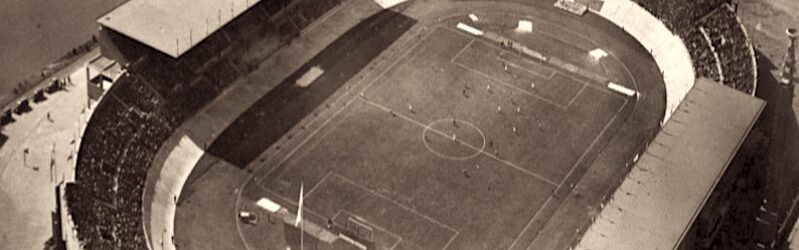
Pedro Acuña’s analysis of photographs from the 1930 World Cup in Uruguay shows how images worked as more than documentary records. They actively constructed meanings about modernity, citizenship, gender, race, and national unity. Photographs of the Estadio Centenario and the Uruguayan crowd and team presented Uruguay as a modern nation capable of hosting a global spectacle. Football appeared as a unifier that gathered citizens across class lines and symbolized social progress at the height of Uruguay’s social-democratic optimism. Acuña also challenges the idea that early football culture was exclusively male. Images reveal women as visible participants,…
-
The module gave me the insight of the FIFA World Cup not only as a sports event, but as a potent historical instrument of studying the nationalism, modernity, and identity of the world. Bowman (2020) in The World Cup as World History reframed the event as a projection of greater political, economic, and cultural pressures rather than sports between countries. As Bowman (2020) demonstrates, the World Cup turned out to be a massive event as the nations could display an image of power, solidarity, and a contemporary image worldwide. This attitude assisted me in perceiving the…
-
The first FIFA World Cup was hosted by Uruguay, a small nation squished between Brazil and Argentina. Despite it’s size, Uruguay had proved it’s soccer prowess, winning both prior Olympic soccer titles. Additionally, Montevideo was home to Conmebol – South America’s Soccer association – making it a hub for soccer in the region. Despite it’s qualifications, Uruguay (and South America as a whole) was not seen as a global soccer powerhouse. Rather, the powerhouse title lay with the nations in which the sport originated – England and Scotland. A lack of belief in South American soccer…
-
Mussolini didn’t just want to host a tournament; he wanted to show off “New Italy.” Everything from the massive stadiums to the way the event was organized was meant to prove that his government was efficient, modern, and powerful. It was one of the first major examples of a country using a global sporting event to boost its international reputation. The authors talk about the “Double Victory.” It wasn’t enough for Italy to host a cool party; the national team (the Azzurri) actually had to win the trophy to prove their “superiority.” The players were basically…
-
In chapter two it gives a brief history of Fifa. It first starts off with the President of Fifa and gives a brief summary of his background. Fifa was officially created in 1904, but the first world cup did not occur until 1930. When it first started, it was mainly continental European countries that participated. British teams on the other hand had opted out from those games. In the first years of Fifa, it primarily consisted of organizing procedures before it sponsored any teams. The national and regional associations were the ones that primarily had sponsored…
