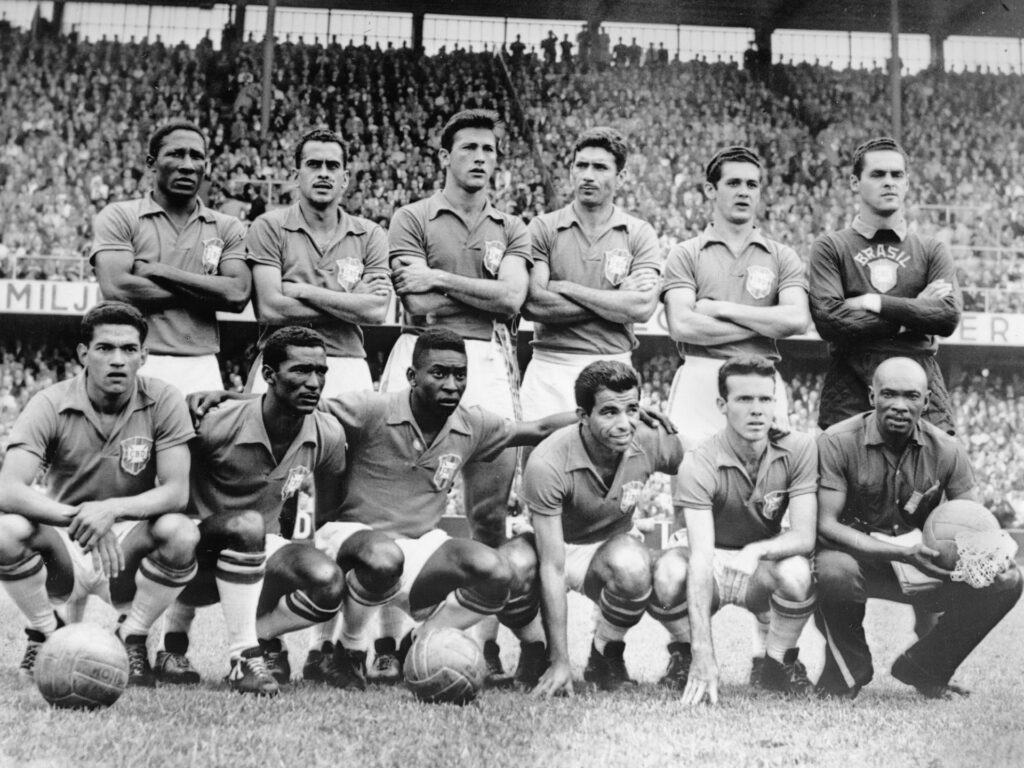
After the conclusion of the Second World War, the FIFA World Cup would continue to be used for political gains, especially by the nation of Brazil, who became completely enamored with the sport of Soccer.
Brazil was looking to prove themselves economically, politically, and as a soccer powerhouse. With their hosting of the 1950 World Cup (the first one since 1938), they were looking to accomplish their goals. They built a massive stadium, the Maracana, to showcase that they were all in on the sport. They almost succeeded in winning the World Cup in front of their home crowd, but would end up getting upset 2-1 by Uruguay. This upset loss stunned Brazilians, which led to author, Nelson Rodrigues, saying, “Our catastrophe, our Hiroshima, was the defeat by Uruguay in 1950.” This would continue to be viewed as the worst thing to ever happen to Brazil until 7-1.
The 1958 World Cup would also be important to the nation of Brazil, where they finally won their first World Cup. This one was not hosted in Brazil, but rather was hosted in Sweden, who they would defeat in the final match, finally showcasing to the world that they were the country to beat. This World Cup was also important as it was the first time that a nation won the World Cup that was not on the continent in which it was hosted, showing that they didn’t need that home advantage to succeed. This feat would be accomplished three more times: 2002 with Brazil, 2014 with Germany, and 2022 with Argentina. Brazil would go on to win the World Cup four more times, including a repeat win in 1962, being the second team to accomplish this feat after Italy in 1934, and 1938. Brazil’s five World Cup victories are the record for most World Cups by any nation.
Like most nations, Brazil has used the FIFA World Cup for political, and economic reasons, and there likely isn’t any other nation that has been so involved in the sport. With their victories showing the world that they are a powerhouse, and their losses being viewed as national tragedies, the sport of Soccer has been a key aspect of the culture of Brazil.
By Tommy Oneto

Leave a Reply