As the title states, this week the legacy and importance of the beautiful game was on full display. The period following World War Two saw an immense growth in the sport, ranging from the 1950 resuming of the World Cup in Brazil, to the election of Joao Havelange as the first Non-European President of Fifa, the World Cup was increasingly growing in importance.
One thing that I knew before the readings this week is that football is of great importance for much of the worlds nations. This is seen all across the globe with football unifying people, creating opportunity, and creating a sense of shared passion. The readings this week drove home this point with lots of new information surrounding the topic.
“Throughout the history of football’s foremost global event, the question was whether the game had the ability to ameliorate some of these tensions and play a constructive political role. Or, on the other hand, did the football matches tend to exacerbate existing political problems?” pg 61 of Bowman The World Cup as World History
I think that this quote sums up the main idea of the readings very well. Focussing on their hosting, and importantly their subsequent runner-up finish of the 1950 World Cup, the Brazilian national team shows how football has the power to unite and divide.
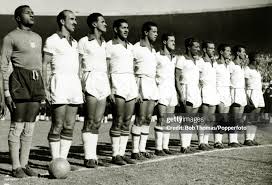
Brazil’s 1950 World Cup Final Squad
The 1950 World Cup was a spectacle for many reasons, it was the first World Cup post World War II isolation era of football, Brazil built a brand new stadium named Maracaná, and a moment for Brazil to highlight itself athletically, economically, and socially (themes that were very apparent in the world cups we have already covered in class)
“You who I already consider champions… you take the field as authentic representatives of Brazil who will prove the worth of the Brazilian people to the entire world” a quote from the President speaking to the team prior to the World Cup Final Match against Uruguay.
Now it is very clear how this World Cup presented such a promising sociopolitical opportunity for Brazil, so how does this prove that football can ‘exacerbate’ political differences?
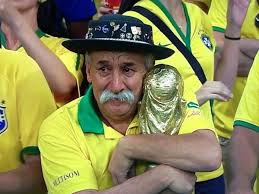
Brazil ended up losing the match 2-1 to a Uruguay – a tragedy for the Brazilian fans, although not from that year (obviously) I think this picture shows how deeply football is rooted in Brazilian culture.
Furthermore, this loss exacerbated the racism problem that was rattling Brazils society in the decades leading up to the World Cup. Many Brazilian fans blamed the loss on the African descended goalie – Barbosa. Some scholars even pointing out that it was decades until an African descended goalie was called up to the national team again.
In conclusion, the World Cup is a beacon of hope for the host country to promote themselves to the world – however it can also have negative consequences domestically (as is the case in 1950).

Leave a Reply