Soccer, like all forms of entertainment, acts like a reflection of everyday life. One moment, the sport can be enchanting and beautiful while at the next it’s chaotic and drama ridden. It is often in the chaos that soccer can become that the sport reflects a common aspect of life: the creation of heroes and villains.
Heroes are quite easy to describe in the world of soccer. These are players who scored under stressful situations, played despite their injuries or the horrible conditions of the pitch, pr lead their teams to victory despite the odds. Villains, in the world of soccer, just line in the wider world itself, are much harder to pinpoint and describe.
Tom Sunderland, writing for Bleacher Report, attempts this in his 2014 article “Ranking the World Cup’s 25 Biggest Villains of all Time.” These villains, as proclaimed by Sunderland, often committed acts of violence (physical or verbal) against the opposing team, cheated, and overall displayed a lack of sportsmanship. Yet, some of these so-called villains, if viewed in a different light, don’t seem so evil.
Take Antonio Rattin of Argentina, ranked number 16 by Sunderland, for example. Sunderland’s descriptions of Rattin’s villainy omits a few key details: Rattin was well within his right to speak with the referee as he was captain of his team and that the referee had no idea what he was saying, as he did not speak Spanish, and assumed Rattin was insulting him. Of course, this is not to disregard Rattin’s actions following the referee’s decision, but context is key to understanding the actions of others. The description given by Sunderland, omitting key details, leads a reader to a view that paints Rattin in nearly-pure villainy.
This idea of the impact of context on perception, as well as situations informing actions, can be seen Simon Critchley’s 2014 article for Roads & Kingdoms, “Working-Class Ballet.”
Critchley briefly discusses the context surrounding Diego Maradona’s (ranked number 2 by Sunderland) “hand of god” goal before delving into Zinedine Zidane (ranked number 7 by Sunderland), speaking primarily about the film titled Zidane: a Portrait of the 21st Century.
Critchley finds himself comparing Zidane to Orpheus – working hard but messing up so badly that he is remember near solely for that action. It seems, almost, that if you remove Zidane’s headbutt against Italian Marco Materazzi you get a person more akin to a hero. Yet, if that moment is removed, is Zidane really Zidane?
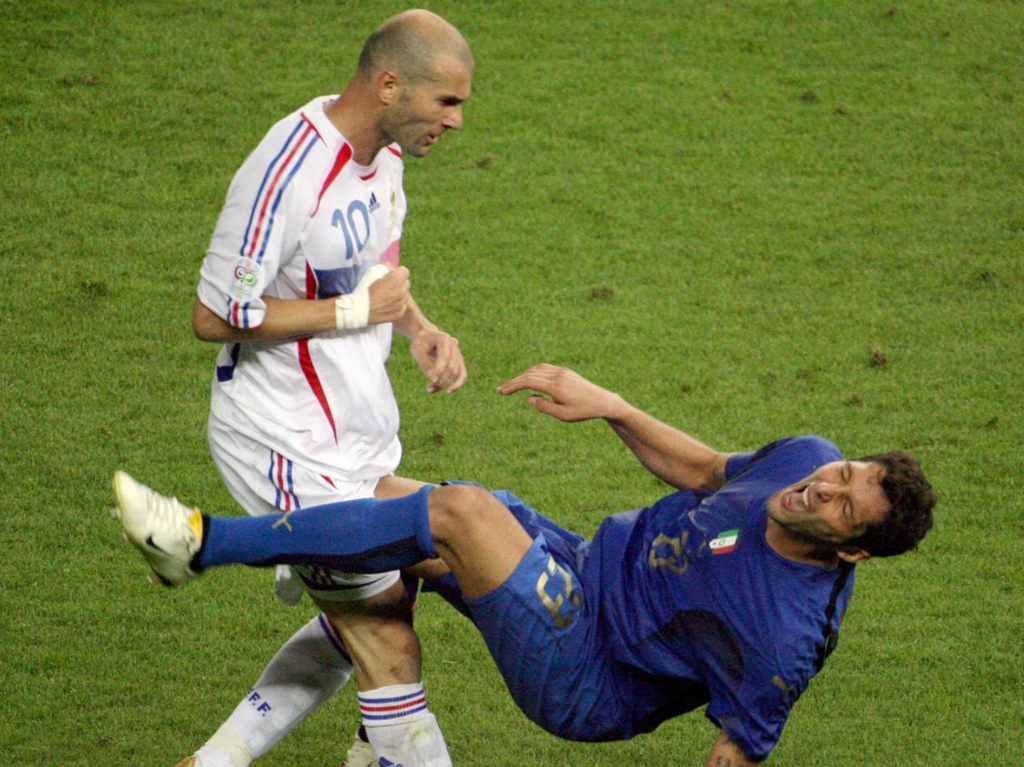
Just like in the wider world, soccer finds itself struggling to understand the grey. Players are often painted in shades of black and white – heroes and villains – when reality often drops them in a contentious grey zone, where context and situations matter to properly understand these players and their actions.

Leave a Reply