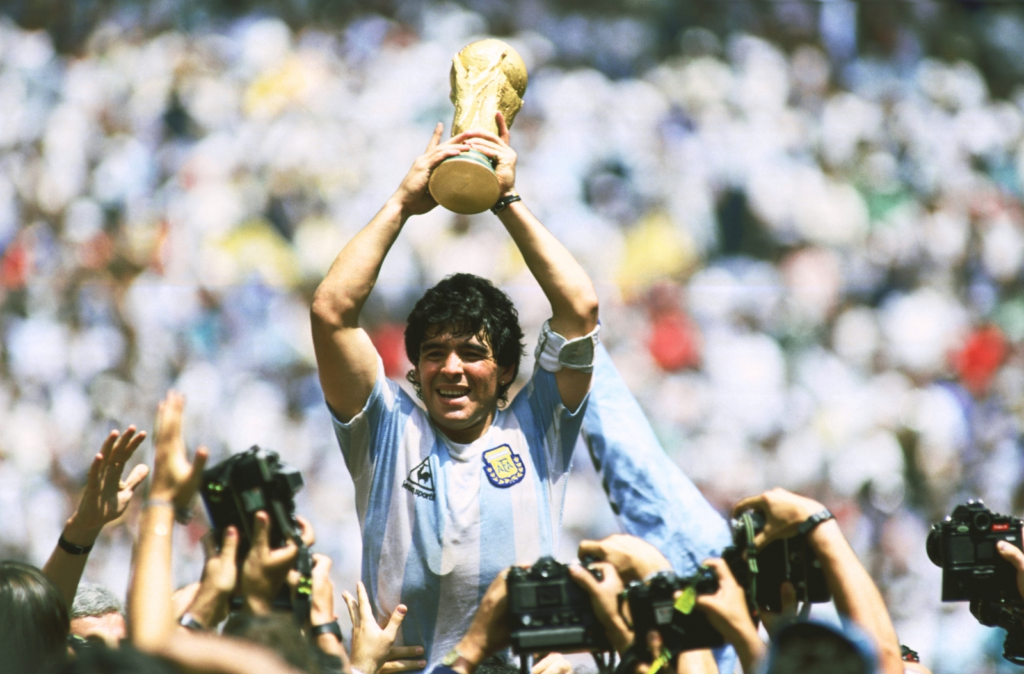
The readings for this week had a distinct focus on the intensity of fandom in football, and with that intensity comes worldwide renown for certain players based on their play or their style of play. Many of the legends of football were birthed by the fans and their intense love for the sport. There are many legendary names in football, such as Diego Maradona, Ronaldinho, Messi, Ronaldo, and many others who are renowned around the world for their stardom in the space of international football. The course literature makes distinct mentions of players like Maradona, who came from a working class slum who grew to have the title of El Pibe de Oro, which translates to The Golden Kid. Legends such as Maradona are one of the elements that make football a spectacle to watch, as mentioned by Bowman in the textbook, noting that star players are “written about as heroes, antiheroes, and supporting cast.” To think of star players as heroes, antiheroes, and supporting casts puts football in a light that shines on the field as a performance, and thus, when tens of thousands of fans show up to watch the games unfold in person, the outcome of the match may create dissent in fans. This can lead to the birthing of “hooligans”, which the textbook describes as fans looking for physical or violent encounters with fans of the opposing side. In 2016, there was an incident between Russian and English outside the stadia at the European Championship in France in which it is also noted that club teams in other nations like Serbia, Argentina, Brazil, and Italy have also had to deal with these “hooligans”. The intensity of fandom in football creates legends out of star players as well as violence outside of the stands. One might say that hooliganism is a part of the spectacle of football as well, but that comes at a cost. In the 1985 European Cup Final between Juventus of Italy and Liverpool of England, thirty-nine people were killed, mostly Italians and six hundred more were injured after opposing supporters rushed and were crushed to death when a wall collapsed at Heysel Stadium in Brussels, Belgium. It highlights how much passion there is for the game but also how that passion can go too far and create dangerous and even deadly situations.

Leave a Reply