Category: Wk11-Spain and Futboleras

  • The goal

    Both the interview and the reading were very insightful. They both seemed to have a direct goal in mind when it came to the purpose of winning. Although neither of those goals are the same. The difference between the reading and the interview is how focused on the goal of the collective. While the other one focuses on the goal of the individual. Typically, people automatically assume that the goal or purpose of winning is the same. But it is the complete opposite. In the interview, Lamine Yamal’s goal was to bring joy to the fans. When it came to the team, the goal was to focus on winning for the Spanish Monarchy. Let’s go a little into detail with the article first.

    The article is focused on the Copa del Rey formally known as Campeonato de Espana. It is the oldest championship in Spain. But the league itself has seen many government system changes throughout the years. It went from monarchy, republic, civil war, dictatorship to democracy. Yet what is interesting, despite all those changes and with it now being a democracy. The goal of the game being played for the Spanish monarchy. But that is where the team is winning together as a collective. Now let’s talk about the interview.

    During the interview, Yamal is asked many questions. From talking about his first car, to talking about his goal for winning. The interview revealed how humble he was. He revealed that his goal was not to be the best person in the field, but to bring joy to the fans who came to watch. It was quite a surprising response because most players today want to be the best on the field. Yet Yamal revealed that that was not his goal at all. Maybe there are many players who like him, or at least should strive to be like him.

    What can be concluded is how both goals are completely different. That does not mean that one brings joy and the other is not. It simply means that as a team, there is a clear objective. But when it comes to an individual the goal is a lot more personal.
  • Week 11, Spain and futboleras

    Football isn’t only about what happens on the field, it’s also a powerful way people express politics and identity, especially during major matches. In Spain, this is really clear in the Copa del Rey, one of the oldest football competitions, dating back to 1903. Adam L. Winkel explains that the tournament isn’t just about winning, but also a place where people express their views about the Spanish nation. Because it’s tied to the monarchy and the state, it often becomes a stage for protest. For example, in 2018 the president of Barcelona encouraged fans to whistle during the final, not just to support the team but to push back against how Catalonians are treated. Moments like booing the national anthem or the king aren’t random, they’re meant to send a message. The Copa del Rey has existed alongside major changes in Spain’s government, from monarchy to dictatorship to democracy, and reflects those shifts. Because of this, it becomes more than a match; it’s a public display of how people feel about Spain and whether they even identify with it as a single nation.

    At the same time, Spain’s national team in the late 2000s and early 2010s shows a completely different side. According to BBC Sport, coach Vicente del Bosque called this period a “great era.” Spain won Euro 2008, the 2010 World Cup, and Euro 2012 back to back, making them one of the most dominant teams ever. What’s interesting is that many players came from regions that don’t always get along, like Catalonia and Madrid. Normally those differences matter, but on the national team they seemed to not matter at all. In the 2010 World Cup final against the Netherlands, the game stayed 0-0 for most of the time. Spain’s goalkeeper made huge saves, the defense stayed strong, and the team kept pushing until Andres Iniesta scored in extra time. When the whole team ran to celebrate together, it showed how connected they were despite their different backgrounds.

    These two examples show how football in Spain can mean very different things at the same time. The Copa del Rey highlights division, protest, and political tension, while the national team represents unity and shared identity. Spain has a long and complicated history with strong regional identities that don’t always align with the idea of one nation. Football doesn’t erase those differences, but it does put them on display, and sometimes, it shows that unity is achievable.

  • Week 11 Spain and Futboleras DIscussion Post BY Grayson Banks

    Football matches have always been bigger than the game, especially when the whole world is watching a country’s national team play in a football match. The King’s Cup in Spain is one of the oldest competitions in football, dating back to 1903. In 2018, the president of Barcelona called for jeering and whistling during the King’s Cup final to not only support FC Barcelona but also to protest certain attitudes held by people towards the Catalonians. He was accused of insulting Spain by calling for this, but he cited the long history of political protest being used for big sporting events like the King’s Cup because these events are a large collection of people who might not be viewed very favorably by the Spanish government and by most Spanish people.

    The Copa Del Rey, also known as the King’s Cup, has long been known to be an exceptional opportunity for soccer fans, political figures, and the media to help express their vision of the Spanish nation. The Copa Del Rey in football has always run parallel to more than a century that was marked by tumultuous changes in government systems in Spain, including monarchy, republic, civil war, dictatorship, and democracy. The trophy given for this competition is always sponsored by whoever is in control of the Spanish state at the time, and by the government they represent. The tournament represents a story that Spain tells about itself as a nation with a strong national identity. But this can often be argued because of all of the people in the country who relate more with their communities and separate states within the nation of Spain. 

    During the mid 2000’s into the early 2010’s, the Spanish national team dominated international competition, even being referred to as a “Great Generation of footballers” that were coming out of the country. During this time, the Spanish national team went on to win three successive international competitions, one of which was the infamous World Cup in South Africa in the year 2010. Despite alot of the players on the national team having heritage from different parts of the world and coming from different areas of Spain that usually don’t get along, the players on this national team were able to get past these differences and see themselves as Spanish first, which helped them to play better together as a team and dominate international competitions for many years. This was demonstrated in the video I watched that showed the Spanish national team’s 1-0 victory against the Netherlands in the 2010 World Cup. The Spanish goalkeeper was a brick wall during this final, making multiple difficult saves that helped to keep Spain in the game. The defence for Spain was also playing extremely hard, and they refused to give up on plays, chasing down players on the Netherlands who were streaking and getting ready to be in a good position for an easy goal. The game remained gridlocked at zero to zero until Andrés Iniesta found the back of the net to give Spain the victory over the Netherlands. The whole team ran to the corner to celebrate with Iniesta after his brilliant goal, showing just how close and connected all of these Spanish players were despite their different backgrounds and heritage.

    The history of Spain is long and convoluted due to the immense amount of different states in the country and the constant unification and separation of these city-states throughout its history. The country also has had a long-standing history of people claiming their city-states more than they would have claimed the entire country. But through the story of the 2010 Spanish national team, we can see that countries can push past these hindrances by coming together as a group and seeing themselves all as Spanish instead of as individuals with different pasts and struggles.

  • What do teams represent

    There has been much discussion revolving political thought and motivations related to soccer. Much of this has concerned the concept of hosting tournaments or the World Cup and there has often been a disconnect in these examples between the actual players and the government of the nation that they represent. However, the national soccer teams are, as one would expect, incredibly important and are often seen as representations of their nation.

    Almost, every team often receives certain characteristics attributed to them and their style of play. These characteristics in turn often influence and are the main way that fans from other nations and those that keep up with soccer view the teams nation as a whole.

    Brazil is perhaps the most recognizable of these teams with their characteristics being defined by a singular term, Joga Bonito (the beautiful game). Many think of the Brazilian team and associate them with artistic flair, style, and individual excellence. On the other side of the spectrum are the characteristics associated with the German national team. They are more so known for their discipline, structure, and teamwork.

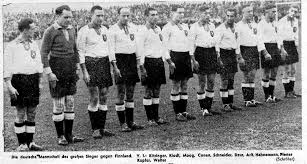
    These characteristics are in turn applied to the nation as a whole. In many cases such as the German team in 1940, these traits are supported by their government. Germany wanted to portray a sense of strength, unity, and coordinated play that represented how they wanted their government to be viewed.

    How these teams and their play are viewed can be seen at a national level as well, not only international. This is where more breaks in the portrayal can be seen as those among the nation are usually, but not always, more aware of what is going on in relation to their own government. In Spain this can be seen through the Copa Del Rey, as it was originally called at its conception in 1903. Throughout the years, Spain has changed the name of the tournament as well as what the tournament stands for in relation to their rulers. Due to this, we see how the representation of a team is not limited to other nations and instead can represent their own local region within the nation. Many teams throughout the years have used this tournament as an opportunity to represent their region and spread awareness of their ideals throughout Spain as a whole.

css.php