Category: Wk05-First World Cups

  • the beginning of politics and propaganda in fifa

    In chapter two it gives a brief history of Fifa. It first starts off with the President of Fifa and gives a brief summary of his background. Fifa was officially created in 1904, but the first world cup did not occur until 1930. When it first started, it was mainly continental European countries that participated. British teams on the other hand had opted out from those games. In the first years of Fifa, it primarily consisted of organizing procedures before it sponsored any teams. The national and regional associations were the ones that primarily had sponsored the teams before Fifa did.

    It is quite interesting how this all started, though this brief summary does not go into deep detail of Fifa. It does lead into the right direction on where it was going to be in the future. This especially is important to note because Fifa is an organization that has the best of the best and does not fail to provide that to fans. It gives fans this sense of belonging because their home teams are representing them in front of the whole world. And also it brings others from other nations to come together and enjoy the world cup. 

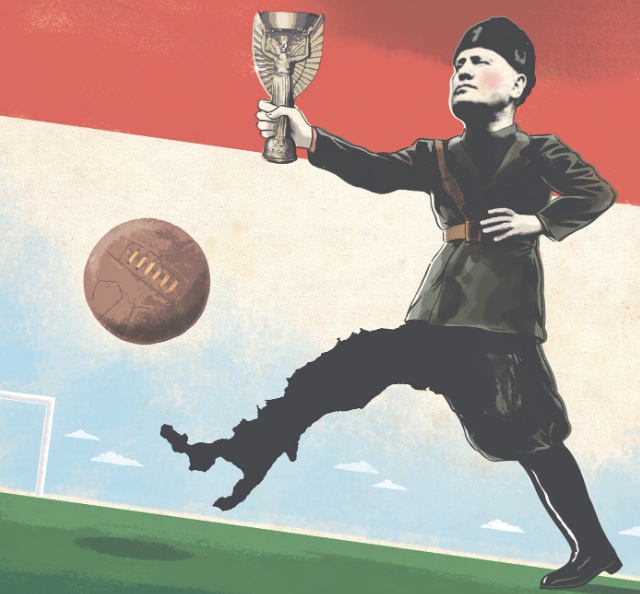
    Things did start to change eventually. Earlier, it was the regional associations that would sponsor the teams. But in 1930, the men’s team were finally starting to get sponsored by Fifa. Rimet, who was the president at the time and Henri Deluany had to convince many of the teams to attend the Uruguay inauguration of the 1930 world cup. Eventually in both 1934 and 1938, many important teams had joined the tournament. These games were appropriated for political purposes, which aimed for Fascists propaganda. This would also be true for Benito Mussolini. Sadly, in 1942, when the games were supposed to take place, the second world war would break out and would halt the games from happening.

    To conclude, it can be clearly seen that the organization of Fifa started to develop and become an important event. A sudden change happened due to politics and propaganda. It would be until 1950 in Brazil when the organization and tournament was reestablished. But for that time, and especially today, politics would be playing a part of it.
  • International Soccer, and Its Political Beginnings

    The readings for this week showcased that the first few World Cups established what would become commonplace in future World Cups, which is its usage by nations for political gains.  

    It started with the Uruguay World Cup in 1930, but this particular story started decades before that with international play in South America.  This international play led to a conference between the nations to establish the CONMEBOL, which was originally based in Montevideo, Uruguay.  This established Uruguay as the center for Soccer in South America, which would later be expanded on with the 1930 World Cup.

    The reasons for hosting the World Cup expand beyond just being the “center for Soccer.”  Yes, they did want to prove themselves to be a soccer powerhouse, which they did with two Olympic gold medals in the sport, and being the first team to not only host, but win a FIFA World Cup, but it also extends to promoting themselves as a nation as a whole.  Prior to hosting the World Cup, and around the same time as the creation of CONMEBOL, Uruguay was going through political reformations, and while they weren’t doing as well economically, they were determined to showcase themselves on the global stage.

    Political gains also extended to the 1934—and to an extent, the 1938—World Cups.  This being with the fascist nation of Italy.  Italy wanted to use the global spotlight to promote their system, and their nation.  With hosting the World Cup, and of course playing in it, they were able to showcase their nation as a powerhouse (even though they played incredibly dirty and faced allegations that the referees were on their side), which they then used for their own political aspirations, and justification for invading the nation of Ethiopia in 1935.

    All in all, the readings established that the development of international play in Soccer has been used for political gains since its very beginnings.  With the establishment of CONMEBOL, and the hosting of the first FIFA World Cup in Uruguay, to the usage of the World Cup for the benefit of Fascist Italy, international play in Soccer has always been political.

    By Tommy Oneto

  • Pictures and Power; How football highlighted political power

    Stretching across the Atlantic, the FIFA World Cup brings a particularly unique opportunity to showcase a country and provide it a political boost. 100 years after its constitution and independence from Spain, Uruguay (the 2 time defending olympic champions) hosted the 1930 World Cup. They used this opportunity to highlight the prosperity of their country as well as celebrate their centennial. Uruguay were eventually crowned champions over their rivals, Argentina, capping off a successful tournament for the nation. In some ways very similar the 1934 World Cup was hosted in an increasingly fascist Italy, who were also in turn crowned champions at home. Mussolini (and other fascist leaders) used sport as a way to enact their social changes, proving the 1934 WC championship was very important for Mussolini

    The 1934 World Cup saw a great expansion in teams from the 1930 version, mostly due to its more centralized location in regards to European teams. I would argue that this increase in size further legitimizes the political/social impacts that the sport has, as it continues to grow and be influential across the globe. Mussolini was able to promote himself and his party/cause through this event – even paying for opposing team fans to come to Italy.

    “Photographers created narrative understandings about football that had broader political and cultural meanings.”

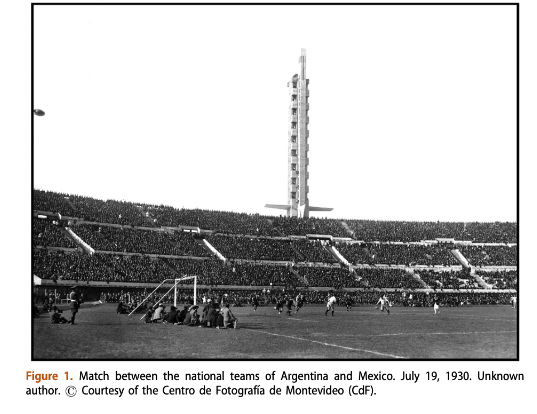
    Jumping back across the pond, I think it is possible that the author of this article slightly overplayed the importance in the hand that photographers played in showcasing Uruguay during the 1930 World Cup, however there is no denying that, similarly to the 1970 WC in Mexico, technological advances played a key role in the overarching importance of the event. These photographs show us not only the players and teams, but also dive into the fans and the infrastructure of the event – something that I would argue really showcases Uruguay beyond just the sport.

    These photographs are a prime example of how Uruguay used this event to showcase itself to the world. Building a new stadium Estadio Centenario and financing other countries stays in the country, Uruguay was serious about using this tournament as a showcase of its national prosperity, even in light of a global financial depression. Although this good fortune would be cut short in the coming years, the pictures remain. Giving us a direct insight into how the World Cup has always been used as a political tool.

  • Politics and the world cup

    Chapter two of The World Cup as World History by William D. Bowman focuses on how the early World Cups were influenced a lot by politics. One major example is the first World Cup in 1930, which was hosted by Uruguay. Even though it was supposed to be a global competition, many European teams chose not to attend. Most European countries were worried about the cost and difficulty of traveling to South America. Only the four European nations of France, Belgium, Yugoslavia, and Romania ended up participating. England refused for a different reason, believing that the tournament was beneath them and that English soccer was already superior to the rest of the world’s.

    Hosting the 1930 World Cup was politically important for Uruguay. The country had already shown its strength in soccer by winning gold medals at the 1924 and 1928 Olympics. By hosting the World Cup, Uruguay wanted to prove its importance within South America, especially against larger and more powerful South American countries like Brazil and Argentina.

    Politics became even more obvious during the 1934 World Cup, which was hosted by Italy under Benito Mussolini’s government. Mussolini used the tournament as a way to promote nationalism and his political ideas, especially as soccer was becoming more popular worldwide. This World Cup included sixteen teams, an increase from thirteen teams in the 1930 World Cup. Uruguay did not participate, partly because of financial struggles but also because they were still upset about European teams refusing to attend the World Cup they hosted in 1930.

    Mussolini pushed political propaganda throughout the competition, using the international attention to advertise himself and his fascist way of rule. England once again refused to participate because of these political differences. Other teams faced challenges as well, including Argentina, whose roster was weakened when many of its top players moved to Italy. Due to shared immigration history, Italy was able to quickly grant these players citizenship.

    Italy won the 1934 World Cup, but their victory was very controversial. Many teams complained about Italy’s aggressive style of play and accused referees of favoritism. Mussolini used this positive momentum to spread his fascist form of government internationally. Overall, these sources show that the World Cup has always been connected to politics, and I believe that the positive or negative result of these games pushes the country forward, or holds them back a little. 

  • How the World Cup is viewed

    The World Cup is an extremely prominent fixture in the sporting world, a competition between nations to see which soccer team reigns supreme. Due to this grand stage, there is an inevitable political aspect to the event. This political side of the World Cup is something that is used by almost all participants and is utilized in several different ways. One of the most prominent manners in which this is seen is through the media side of the competition. News stories, videos, and pictures are all a part of the World Cup and are all used to show aspects of the teams for cultural and political purposes

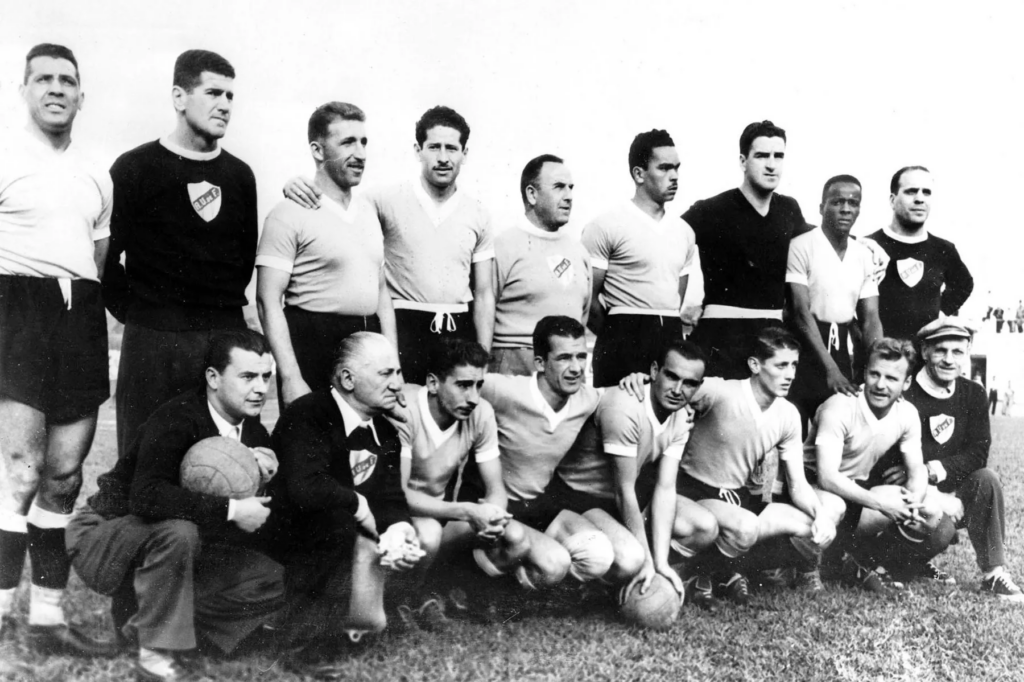
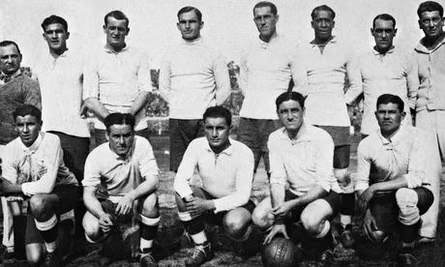
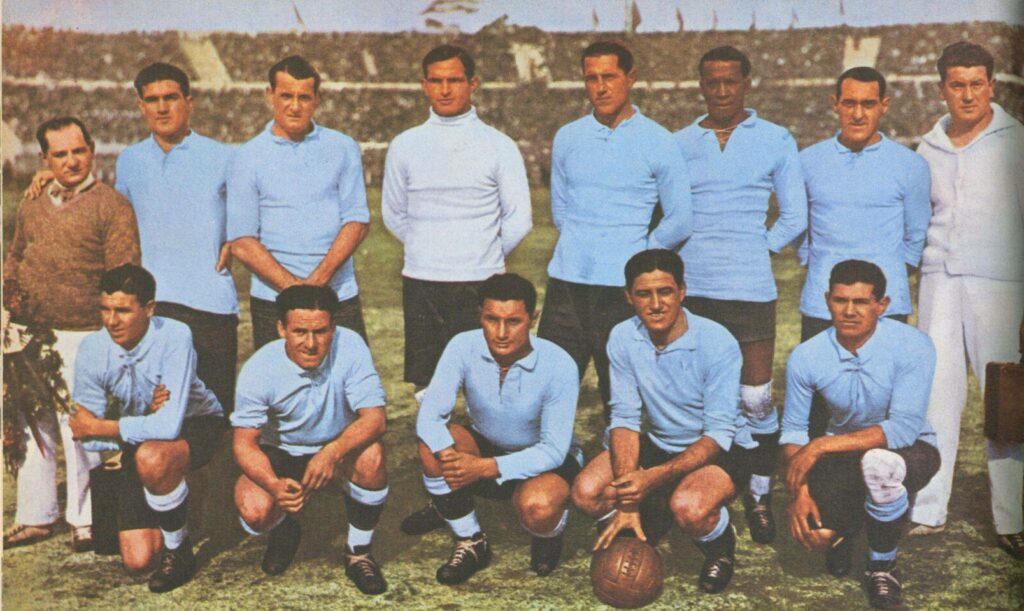
    Team photos were not only a way to commemorate the team and their possible success in the tournament, but were also a way to celebrate the brotherhood between the players. This in turn was a celebration of the nation itself and often a way of presenting a form of unity, that in some cases but not be truly representative of the situation of the nation. While some pictures such as the one above of the victories Uruguay team in 1930 can be a heartwarming piece of history, others such as pictures of the Austrian team in the 1930’s belay the political unrest that was occurring in the country. Whether from internal issues or external affairs, the World Cup for some can be a last ditch effort to present a united front and the nation as desired. Whether it is trying to be seen as modernizing or an effort to promote local soccer, how people view the World Cup and not only their nation’s performance, but behavior as well is something that seems to be almost always presented with intention.

    Something that often comes up in regards to national teams, whether they are participants in the World Cup or the Olympics is the composition of said national team. Earlier on in the World Cup’s lifespan the rules on who could play for a national team were much less strict. This often led to questions about whether or not the team playing was truly representative of the nation itself. This team composition was yet another aspect of the World Cup that could be used for political purposes. Whether it was used to promote diversity or to question the diversity, it was a prime example of how one topic could be viewed in multiple different ways depending on the presentation.

  • When Football Became Politics – Wk05

    The first-ever World Cup in 1930 wasn’t just about football,it was about proving something to the world. Uruguay, a small South American nation celebrating its 100th anniversary of independence, wanted to show its neighbors Argentina and Brazil that it belonged on the world stage. After winning back-to-back Olympic gold medals, the Uruguayans had the credentials. What they needed was the platform. But getting European teams to make the long ocean voyage proved nearly impossible. Only four showed up, and England, football’s birthplace, sent a dismissive note declining the invitation, a blunder that would haunt them for a generation. Uruguay won the final 4-2, but bitterly refused to defend their title in 1934 when the tournament moved to Mussolini’s Italy.

    What makes 1930 fascinating is how the tournament was captured and remembered. Photographers known as “Chasirettes” created images that told stories about who belonged in modern Uruguay. Women attended matches despite football being seen as a masculine space. José Andrade, nicknamed “The Black Marvel” by the French press, stood proudly in team photos despite racist attitudes of the era. Most striking was Héctor Castro, who scored the final goal despite having lost his right hand in a childhood accident. In the team portrait, he deliberately hides his disability, revealing anxieties about projecting a “perfect” national image even as these photos celebrate diversity.

    The 1930 World Cup marked both a peak and an ending. Uruguay’s progressive era, with labor rights, women’s suffrage, and economic prosperity, created the conditions for hosting. But within months, economic depression triggered authoritarianism across Latin America. Meanwhile, the 1934 tournament in fascist Italy showed football’s darker potential. Mussolini used the World Cup as propaganda, and Italy’s controversial victory fueled aggressive policies. The pattern was set,  football had become inseparable from politics, nationalism, and power, a reality still playing out in World Cups today.

  • Week 5 By Grayson Banks

    In The World Cup as World History by William D Bowman, chapter two focuses on the politics behind the first couple of World Cups, like the 1930 World Cup in Uruguay, where a lot of significant European teams declined the offer to participate in the World Cup. The four European nations that went to the first World Cup were France, Yugoslavia, Belgium, and Romania. Most European countries were concerned about the cost of travel and the logistics of getting their teams to Uruguay, except for Britain, which believed that the competition was beneath them and that English soccer was better than any other soccer team in the world.
    The 1930 World Cup also held a lot of political significance because one of the main reasons it was hosted in Uruguay was because it had already shown its soccer prowess on the national stage in the 1924 and 1928 Olympics. Uruguay also wanted to prove its position in South America, especially to its much bigger and stronger neighboring countries of Brazil and Argentina.
    The 1934 World Cup in Italy was also used as a political display for Benito Mussolini’s fascist regime. The ultranationalist and anti communist views of Mussolini had started to intertwine with sport as sports started to rise in popularity across the world, including soccer. Sixteen teams competed in this World Cup, which was an improvement over the World Cup in Uruguay, which only saw thirteen teams compete. Uruguay did not compete in this world cup however as the national team was having financial difficulties, and they were still angry about European teams like England refusing to come to the country to participate in the World Cup.
    The 1934 World Cup took on very serious political undertones being pushed by Mussolini, who used the international platform he was provided by the competition to advertise himself and his movement insistently. This caused England to reject the invitation to participate in the World Cup again. Many teams went through issues with playing in the tournament like Argentina, which was the runner-up in the 1930 World Cup, who had their roster severely weakened by a lot of the better players on their roster choosing to migrate and play for Italy instead. Argentina and Italy had a long history of shared immigration, and the Italian government was able to nationalize the new Argentinian players very quickly.
    Other countries’ teams like Austria, Hungary, and the Czech Republic had formed a center of footballing excellence in the 1920’s and 30’s, but political strife in all of these countries affected their players’ effort and play on the pitch. Italy won the1934 world cup by playing a very aggressive and foul-heavy form of football that a lot of other countries complained about, and some even claimed that Italy had the ref in their pocket. But Mussolini denied all of these claims and celebrated the World Cup win fully because a world championship is worth its weight in gold for political propaganda.
    After the World Cup, Italy started to move aggressively into overseas military campaigns, like when they started fighting Ethiopia in 1935 and when they supported the authoritarian nationalist Francisco Franco in the Spanish Civil War in 1936. While you cannot directly connect world politics to international sporting competitions, it is safe to say that Italy’s confidence was very high after winning the World Cup in 1934.
    International sporting competitions are always a good time to show what your country is about and project your beliefs on a global scale. I think the World Cup connects to politics almost as much as it connects to the sport of soccer itself.

css.php