Stretching across the Atlantic, the FIFA World Cup brings a particularly unique opportunity to showcase a country and provide it a political boost. 100 years after its constitution and independence from Spain, Uruguay (the 2 time defending olympic champions) hosted the 1930 World Cup. They used this opportunity to highlight the prosperity of their country as well as celebrate their centennial. Uruguay were eventually crowned champions over their rivals, Argentina, capping off a successful tournament for the nation. In some ways very similar the 1934 World Cup was hosted in an increasingly fascist Italy, who were also in turn crowned champions at home. Mussolini (and other fascist leaders) used sport as a way to enact their social changes, proving the 1934 WC championship was very important for Mussolini
The 1934 World Cup saw a great expansion in teams from the 1930 version, mostly due to its more centralized location in regards to European teams. I would argue that this increase in size further legitimizes the political/social impacts that the sport has, as it continues to grow and be influential across the globe. Mussolini was able to promote himself and his party/cause through this event – even paying for opposing team fans to come to Italy.
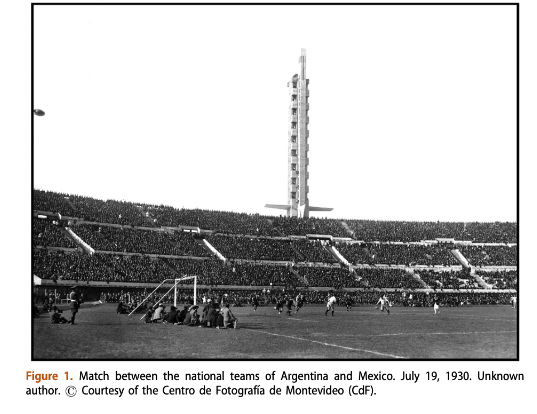
“Photographers created narrative understandings about football that had broader political and cultural meanings.”
Jumping back across the pond, I think it is possible that the author of this article slightly overplayed the importance in the hand that photographers played in showcasing Uruguay during the 1930 World Cup, however there is no denying that, similarly to the 1970 WC in Mexico, technological advances played a key role in the overarching importance of the event. These photographs show us not only the players and teams, but also dive into the fans and the infrastructure of the event – something that I would argue really showcases Uruguay beyond just the sport.
These photographs are a prime example of how Uruguay used this event to showcase itself to the world. Building a new stadium Estadio Centenario and financing other countries stays in the country, Uruguay was serious about using this tournament as a showcase of its national prosperity, even in light of a global financial depression. Although this good fortune would be cut short in the coming years, the pictures remain. Giving us a direct insight into how the World Cup has always been used as a political tool.

Leave a Reply