Category: Wk07-Post-WWII & Cold War era

  • Black & Immigrant Players Around the Globe

    <- Image Details

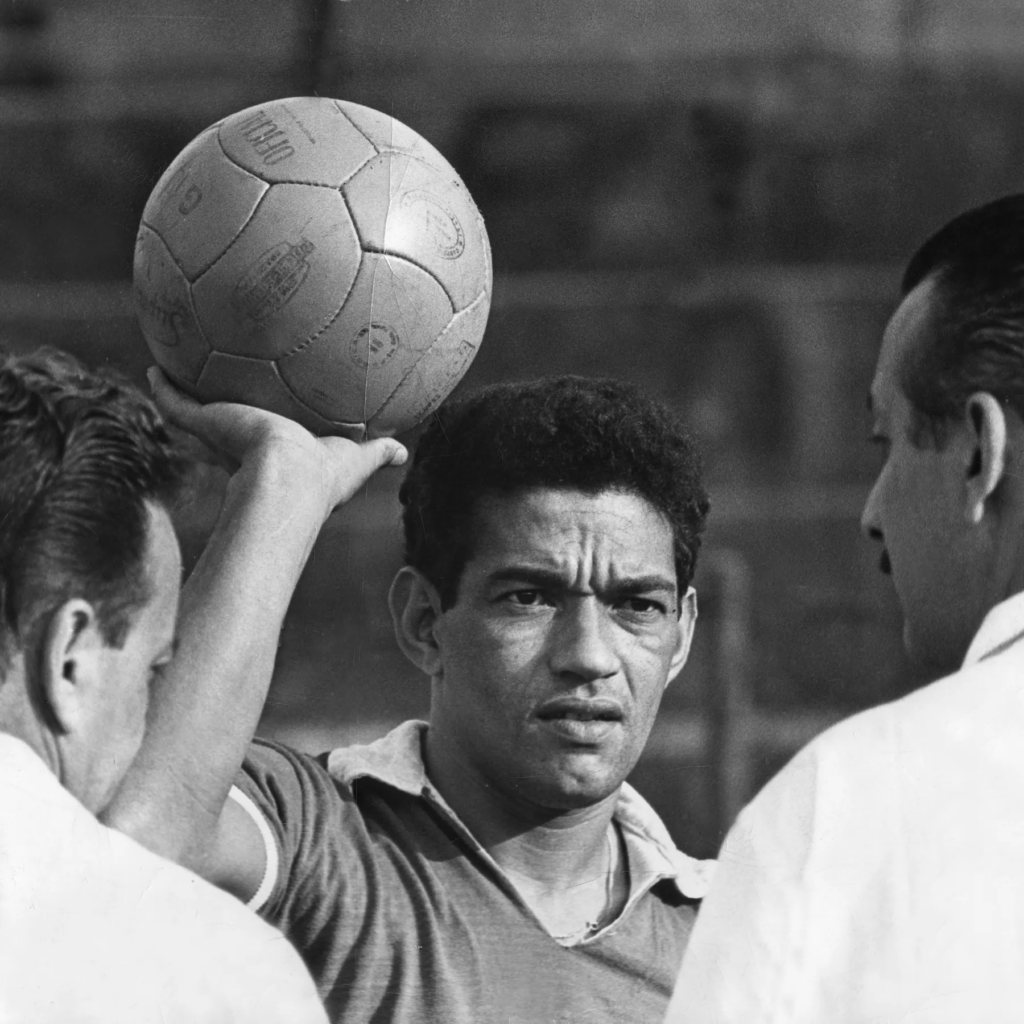
    Garrincha, one of the main talking points of this week’s reading, as a dominant “Afro-Brazillian” player.

    The overarching theme of the readings is bringing to light some high flying names of great black players throughout different eras, as well as documenting the struggles these same players have had to face for the color of their skin. This includes barring from playing for national teams as well as ridicule from the media for not “truly representing” their national team.

    One of the players highlighted through the readings if Brazilian player Manuel Francisco dos Santos, or Garrincha. Born with deformed legs that had his knees bend at awkward angles, this gave him a unique advantage to the dribbling aspect of soccer mostly. This skillset let him be one of the most important pieces of the 1958 and 1962 World Cup victories for Brazil, along with his teammate Pele.

    While discrimination against Garrincha specifically was not a focal point of the readings, the main talking points were the French national teams of the 1930s, and the German national team of 2014. Larbi Benbarek was mentioned by name as playing for the French national team even though born in the French territory at the time, Morocco, and not possessing a French passport. The German national team had possessed German citizen players who were born to immigrant parents, highlighting Mesut Ozil (Turkish) Jerome Boateng (Ghanaian) and Sami Khedira (Tunisian.) These players were sought after by name in the media as being “undesirable neighbors” and not correctly representing the German people.

  • Garrincha the Great

    Brazilian soccer player Garrincha was a star player back in the day. His dribbling and shooting abilities were unmatched during his hayday and he became one of soccer’s most successful players. Despite being born with an extremely disabled leg, he was one of Brazil’s greatest players. He was among the star players who immortalized Brazil’s name in the soccer world.

    His debut performance was during Brazil’s match against the USSR, where he played alongside a young Pelé. He transformed the game by leading the charge in a new, much more offensive-based play style. He would eventually help his team achieve a 5-2 victory against Sweden in the 1958 World Cup. After their victory, Garrincha and Pelé were boosted to celebrity status for their performances.

    However, it was his performance in the 1962 World Cup that truly made him a world star. After Pele was sidelined for an injury, he stepped up to help lead the team. During this tournament, he scored four goals, including an insane header against England and a long-range goal against Chile.

    After the tournament, he was named Player of the Tournament and brought the title back to Brazil. The 1966 World Cup marked his final appearance in the tournament. His remarkable record of only one defeat and fifty wins with Brazil was his legacy. He had earned titles such as the “King of Dribbling” and was immortalized as a symbol of Futebol Arte.

    He died in 1983 from a complication of cirrhosis in the liver, a result of years of alcohol abuse. The tragic end to the legend’s life did little to squander his reputation. His image as an artist of football is still present to this day. Going into this class i was not familiar with many Brazilian soccer players. But, after this video and a little side research, I will remember his incredible legacy.

  • Week Seven Discussion

    This section of the book, The World Cup as World History by William Bowman, focuses on the negative stereotypes players receive when they have a different heritage than the national team they are playing for. 

    An example of this in the text is the 2014 German national team, which fielded a bunch of players who weren’t one hundred percent ethnically German. Some players of note are Miroslav Klose, whose family is originally from Poland, Mesut Ozil, the midfielder who is from a Turkish background, and Sami Khedira, who is of Tunisian heritage. Mesut Ozil was born in Germany and came up playing in a local club around the area where he was born, called Schalke 04, before he eventually moved his way up to Arsenal by the end of his career. Despite being born in Germany and playing in and winning a World Cup with the the german national team, Ozil’s Turkish heritage complicated his playing career as alot of people didn’t view him as truly German. 

    This increase in migrants to Germany is relatively new, however, as German immigration laws have previously made it very hard to immigrate to the country and still receive the same rights that naturalized German citizens already have. Germany’s super strict citizenship laws, which had been in place since 1913 and were removed in 2000, made it extremely hard to receive citizenship if you were a minority coming from another country. 

    Germany isn’t the only country that has been dealing with the problem of stereotypes and discrimination in World Cup events. Brazil has also had a very storied history in its path to winning five World Cup titles. The Brazilians were super excited to host the 1950 World Cup and show off their country and how rapidly the economy had been growing. And the tournament went great for Brazil until the final, where, heartbreakingly, the Brazilians lost 2-1 to an underpowered Uruguayan national team in front of thousands of loyal Brazilian fans.

     After this game, many Afro-Brazilian players were sent death threats and desriminated agaisnt, and this event led to Brazil deciding to have only players of European descent play on their national team for the next couple of years. This changed when a bunch of young, exciting, and ethnically diverse Brazilians went on to win three World Cup titles in 1958, 1962, and 1970. Names like Vavá, Didi, Mário Zagallo, Garrincha, Rivellino, Nilton Santos, Gérson, Tostão, Jairzinho, and Carlos Alberto all shone and showed off their different heritages on the biggest stage in the world, showing that despite their differences, they were all still Brazilians. The biggest player of Afro-Brazilian descent who played for the national team, however, was Pele whose poise and grace with a soccer ball allowed him to not only capture Brazilian favor but also the favor of other countries, who really liked to watch him play. 

    I think that ignorance is the main cause of discrimination against certain players on these national teams and when these teams are good, like the German side who won the World Cup or even legendary like the Brazilian teams of the 60’s and 70’s it helps people to open their eyes more and see individuals who may look different than them in a more positive light. Winning really helps to put players on a pedestal in the eyes of the world and their country, and I think more places should embrace their strong immigrant communities and find ways to show respect to that culture, but also still recognize them as citizens of that specific country. 
css.php